
After an accident, your car may end up sitting in the driveway, looking like a lost cause. As insurance calls come in and friends offer conflicting advice, figuring out what to do next can be frustrating. Many people assume a badly damaged car is worth almost nothing, but selling it too quickly can mean leaving money on the table.
Knowing how to sell a wrecked car starts with understanding what still holds value. Even if the car no longer runs, its parts, metal, and electronics may attract buyers. This guide explains how to handle insurance and title paperwork, find the right buyers, and decide whether selling the car whole or for parts makes more sense. You’ll also learn how to compare offers and complete the sale safely.
Key Findings
- 23.1% of auto insurance claims were flagged as total losses. According to CCC Intelligent Solutions’ 2026 Crash Course Report, the share of claims classified as total losses reached a record 23.1% in 2025 across all loss categories.
- More than 70% of total-loss valuations involved vehicles at least seven years old. CCC reported that over 70% of total-loss valuations in 2024 involved vehicles seven years old or older, highlighting the relationship between vehicle age, depreciation, repair expenses, and total-loss decisions.
- Copart sold more than 4 million vehicles in fiscal 2025. Salvage and vehicle auction company Copart reported selling more than 4 million vehicles worldwide during its fiscal year ending July 2025. Its buyers include dismantlers, rebuilders, dealers, and exporters.
- More than 4 million vehicles are recycled annually in the U.S. and Canada. The Automotive Recyclers Association states that professional automotive recycling businesses process over 4 million motor vehicles annually across the United States and Canada.
- Recycled original vehicle parts can cost 20–80% less than new parts. According to the Automotive Recyclers Association, recycled OEM vehicle parts can cost 20% to 80% less than new parts. This helps explain why dismantlers buy damaged vehicles for reusable components.
How to Sell a Wrecked Car
Begin by checking your insurance status, vehicle ownership, and title paperwork. Then decide whether to sell to a junk car buyer, online buyer, dealership, or private party. Consider whether selling the car whole or parting it out makes more sense, compare offers, and prepare the vehicle for pickup, payment, and ownership transfer.
The process is similar for wrecked and totaled cars. However, a total-loss insurance decision can affect ownership, title requirements, and whether you can sell the vehicle yourself.
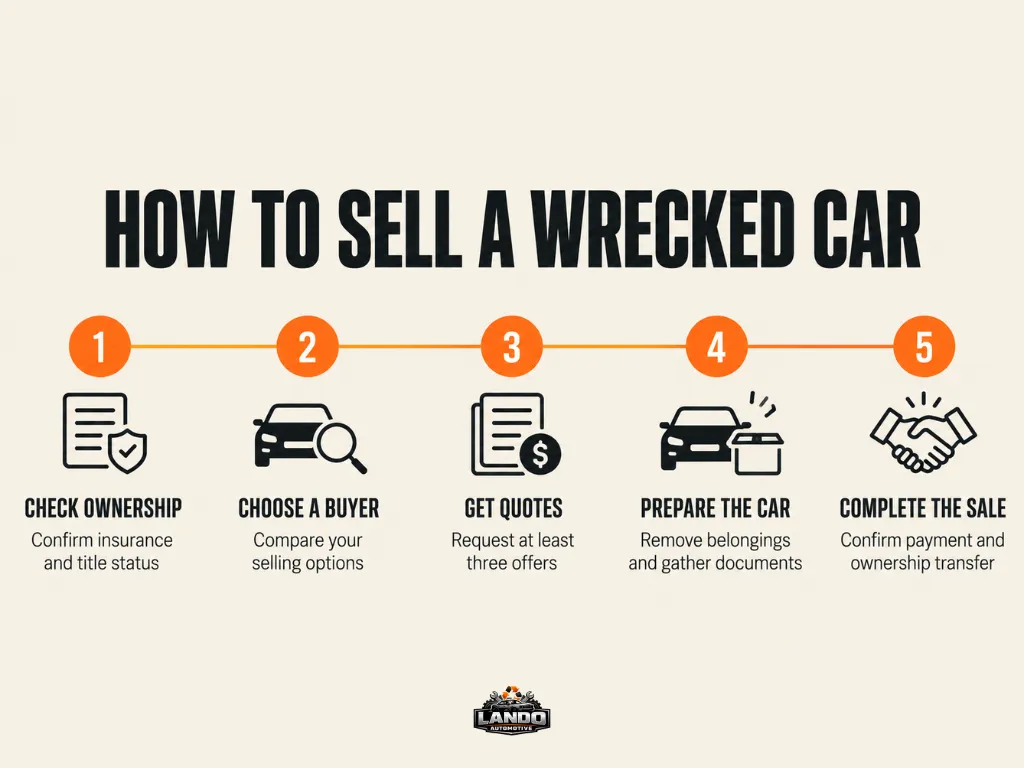
- Check your insurance status and title before you sell
Start with where you stand. If an accident caused the damage, your insurance claim may still be open, and that determines who is allowed to sell the car.
An insurer declares a car a total loss when the cost to repair it is too high compared with what the car was worth before the damage. The cutoff varies by state and insurer, and some use a percentage of the car’s value while others use a formula. Once a car is totaled, the insurer usually pays you its pre-accident value, minus your deductible, and the vehicle typically receives a salvage title.
How to sell a totaled car after a total loss claim
After a total loss claim, you can accept the insurance payout and let the insurer keep the car or retain it for a reduced payout and sell it yourself. Before deciding, compare potential buyer offers against the amount your insurer would deduct.
Since payouts, salvage rules, and retention rights vary by state and insurer, confirm the details with your adjuster and state DMV. If the car has a salvage title, you must also disclose its status to potential buyers.
Documents to have ready
To sell your wrecked car, you’ll generally need a title in your name (or salvage title), photo ID, current registration, and a bill of sale if required by your state. If you don’t have the title, check the requirements for selling a car without a title.
If you still owe money on the vehicle, the process involves an additional step. Contact your lender to arrange a payoff or obtain approval before transferring ownership, and review the requirements for selling a car with a lien to avoid delays.
- Pick a type of buyer
You have four main selling options, each suited to different vehicle conditions. Depending on the buyer, your car may be repaired, rebuilt, or sent for dismantling and recycling. If it cannot return to the road, the junk car recycling process determines which parts and materials can be recovered.
Junkyards and salvage yards
Junkyards and salvage yards. A yard buys the car by its parts and metal value, not by its cosmetic condition. The distinction between a scrap yard and junkyard matters here, as scrap yards focus on recoverable metal, while junkyards also value reusable vehicle parts. A yard typically tows the vehicle, drains the fluids, removes parts it can resell (engines, transmissions, alternators, doors, mirrors), and sends the remaining shell for metal recycling.
To sell to a yard, you usually need to provide the title or proof of ownership, your ID, the car’s year, make, model and condition, and a pickup location. Document rules vary by state, so confirm what a specific yard requires before you call. Yards are a strong fit for non-running cars because the tow is often free and payment is quick.
Online car buyers
Online car buyers quote you from a form and photos, then arrange pickup through a local partner. They are convenient and work well for any condition, but quotes can shift if the car doesn’t match your description.
Dealerships
Most dealers prefer cars they can resell, so they often pass on wrecks or offer low prices. They make the most sense when you are trading in a drivable car with minor damage toward a new purchase.
Private buyers
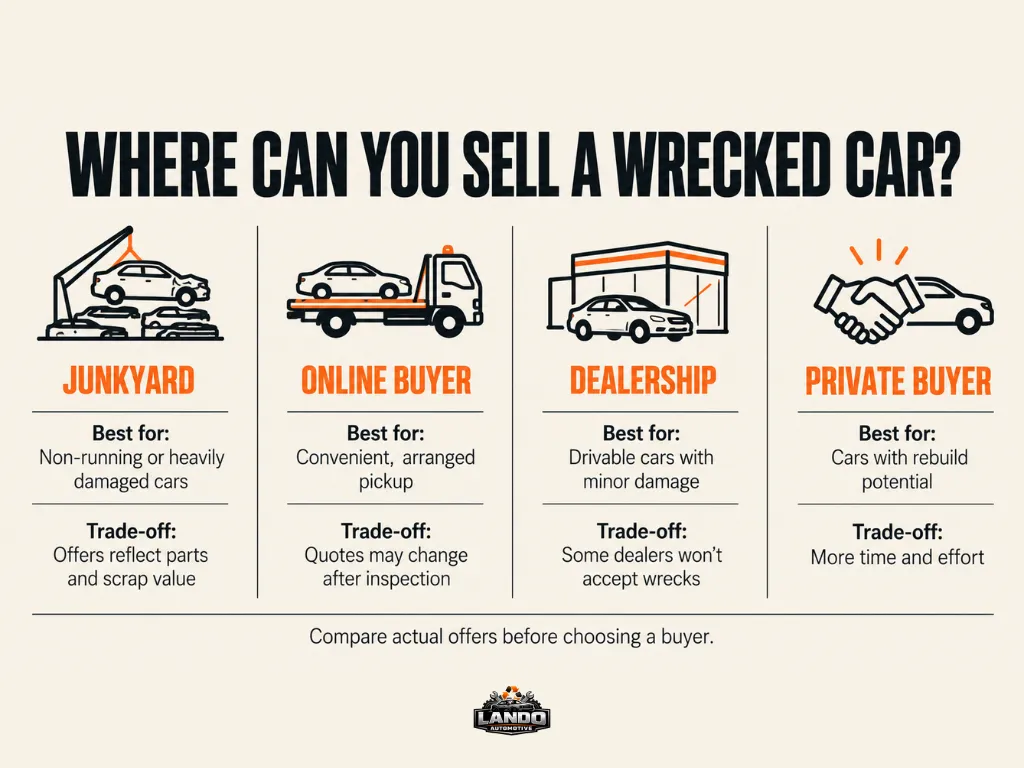
Mechanics, rebuilders, and hobbyists may pay the highest price, especially for popular or rare models. The trade-off is time, because you handle the listing, the calls, the no-shows, and the paperwork.
| Buyer Type | Speed | Payout | Effort | Best For |
| Junkyard/Salvage Yard | Fast (often days) | Low to medium | Low | Non-running, heavily damaged or old cars |
| Online Car Buyer | Fast | Medium | Low | Any condition, convenience seekers |
| Dealership | Fast | Low | Low | Trade-ins with minor damage |
| Private Buyer | Slow | Potentially high | High | Drivable wrecks, rare or in-demand models |
- Choose between whole car or parts
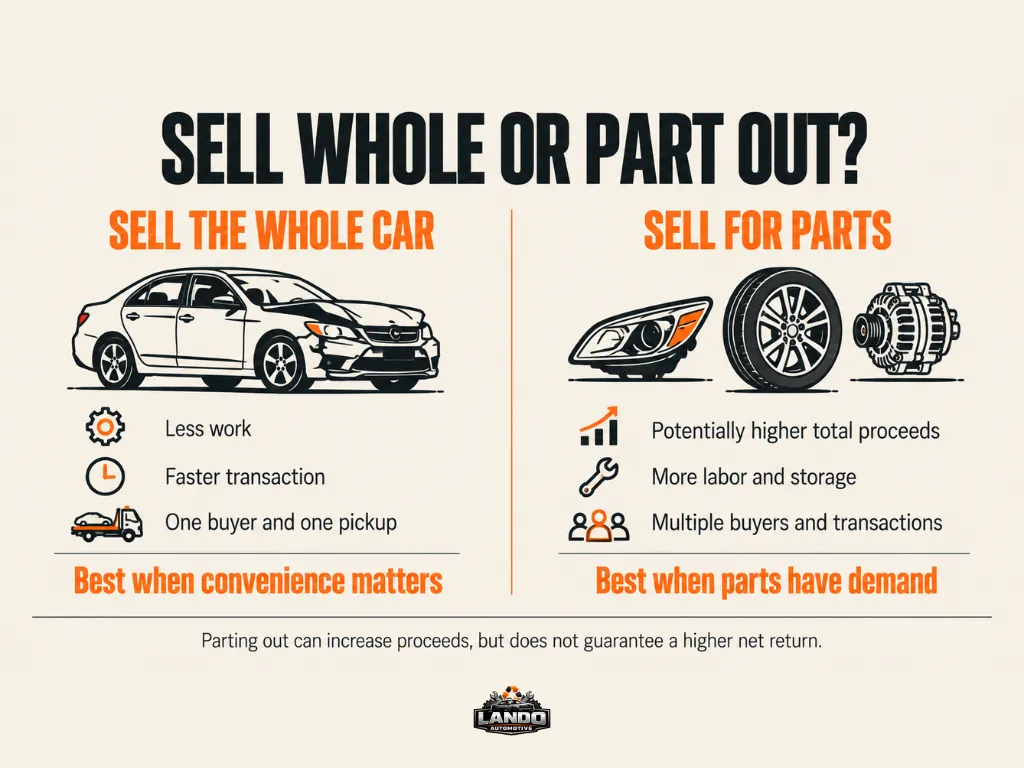
Parting out a wrecked car can earn more than selling it whole, but it also requires more effort. If you’re wondering how to sell a wrecked car for parts, you’ll need the tools and skills to remove components, plus time to find buyers, arrange shipping, and handle returns.
You’ll also need space to store parts and the remaining vehicle, along with a way to handle fluids and other waste. Since the process can take weeks or months, selling the car whole is usually more practical if you’re short on time, equipment, or space.
Which parts are worth pulling
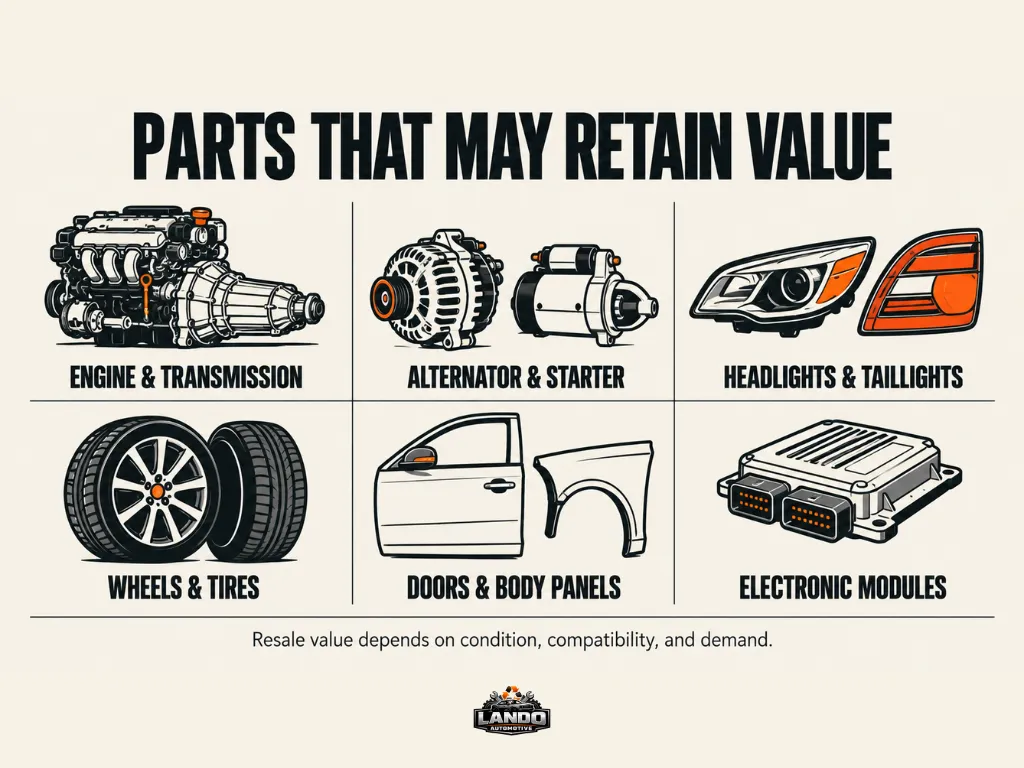
Parts that tend to hold resale value include:
- Engine and transmission (if they are undamaged)
- Catalytic converter (it also has scrap value, and laws on its sale are strict in many places)
- Alternator and starter
- Infotainment unit, instrument cluster, and control modules
- Headlights and taillights
- Doors, hoods, fenders, and trunk lids, especially in a popular color
- Wheels, tires, and seats in good shape
Demand depends on your car’s make, model, and year, so check what similar parts have sold for rather than guessing at prices. Drain and contain fluids safely, store them in sealed containers, and take them to a recycling or hazardous-waste drop-off. Never pour them on the ground or down a drain.
Selling the best parts and the rest separately
The hybrid route often works best: sell the high-value parts yourself, then sell the stripped shell to a yard. You capture the parts premium without the burden of disposing of the whole car. Parts typically sell on online marketplaces, auto-parts forums and local classifieds, and to local body shops or mechanics. Tell the yard in advance which parts you removed, because the quote for the remaining shell will be lower.
- Compare quotes fairly
Before comparing offers, you can estimate your car’s scrap value to get a rough starting point. This won’t determine what a buyer will pay for usable parts, but it can help you assess the metal-value portion of an offer. Get at least three quotes, and ask every buyer the same questions:
- Is towing included, or is there a pickup fee?
- Are there any other fees deducted from the offer?
- Does the quote hold at pickup, and under what conditions would it change?
- How and when will I be paid (cash, check, or transfer)?
- Which documents do you need?
Describe and photograph the damage honestly. Show every side, the interior, the odometer, and any flood or fire damage. An accurate description keeps the quote from being cut when the driver arrives.
- Prepare the car for pickup
Before pickup, check the items to remove before scrapping, including personal belongings in the glove box, trunk, and under the seats. Also, remove your license plates if required by your state and take out any aftermarket accessories you want to keep, such as a stereo or wheels.
Once the sale is complete, keep a copy of the bill of sale and check your state’s DMV notification requirements. You may need to file a release of liability or notice of transfer to document the change of ownership. After the vehicle has been picked up and the paperwork is complete, contact your insurer to cancel or adjust your coverage.
Frequently Asked Questions
Do I need to repair a wrecked car before I sell it?
No. Repairs rarely pay for themselves, and junkyards and online buyers purchase cars as-is.
How long does it take to sell a wrecked car?
Sales to yards and online buyers can close in a few days, sometimes faster, while private sales and parting out can take weeks or months. Lien payoffs and title issues are the usual causes of delays.
Can I sell a wrecked car that was damaged by flood or fire?
Yes. Many junkyards and online buyers accept flood- and fire-damaged vehicles, with offers based on their usable parts and scrap value. Be upfront about the damage and any salvage or flood designation on the vehicle’s title.
Can I donate a wrecked car instead of selling it?
Yes, and some charities accept non-running cars. Tax benefits depend on how the charity uses the car and on your own tax situation, so check with a tax professional and verify that the charity is legitimate. You can also sell the car and donate the proceeds.
Can I sell a wrecked car if another person is on the title?
Usually both owners must sign, depending on how the title is worded (“and” versus “or”). If a co-owner is unavailable, your DMV can explain what is required.
Final Takeaway
How to sell a wrecked car depends on its condition, remaining value, and how quickly you want to complete the sale. While junkyards and online buyers offer a faster option, selling privately or parting out the vehicle may bring a higher return. The key is to compare offers rather than accept the first price you receive.
Regardless of which option you choose, be upfront about the damage, confirm payment arrangements, and complete the necessary paperwork. A little preparation can help you get a fair price and avoid complications after the sale.