
Selling an old, damaged, or non-running car to a junkyard is often a practical way to get money for a vehicle you no longer need. However, not every car receives the same offer. Some are valued mainly for scrap metal, while others are worth more because of their reusable parts.
So, how much will a junkyard pay for a car? The answer depends on its weight, condition, completeness, and demand for parts. This guide covers typical payouts by vehicle type, explains how junkyards calculate offers, and highlights the factors that can increase or reduce your payment. It also shows how to compare quotes and avoid unexpected deductions.
Junkyard Payouts by Vehicle Type
How much will a junkyard pay for a car depends on vehicle type, condition, and value to the buyer. Pull-A-Part estimates $250-$500 for many junk cars, while Reap My Ride advertises a broader $300-$1,500 range. Meanwhile, Cash Auto Salvage reports a $400 median payout across its purchase records. These are company-reported figures, not nationwide averages.
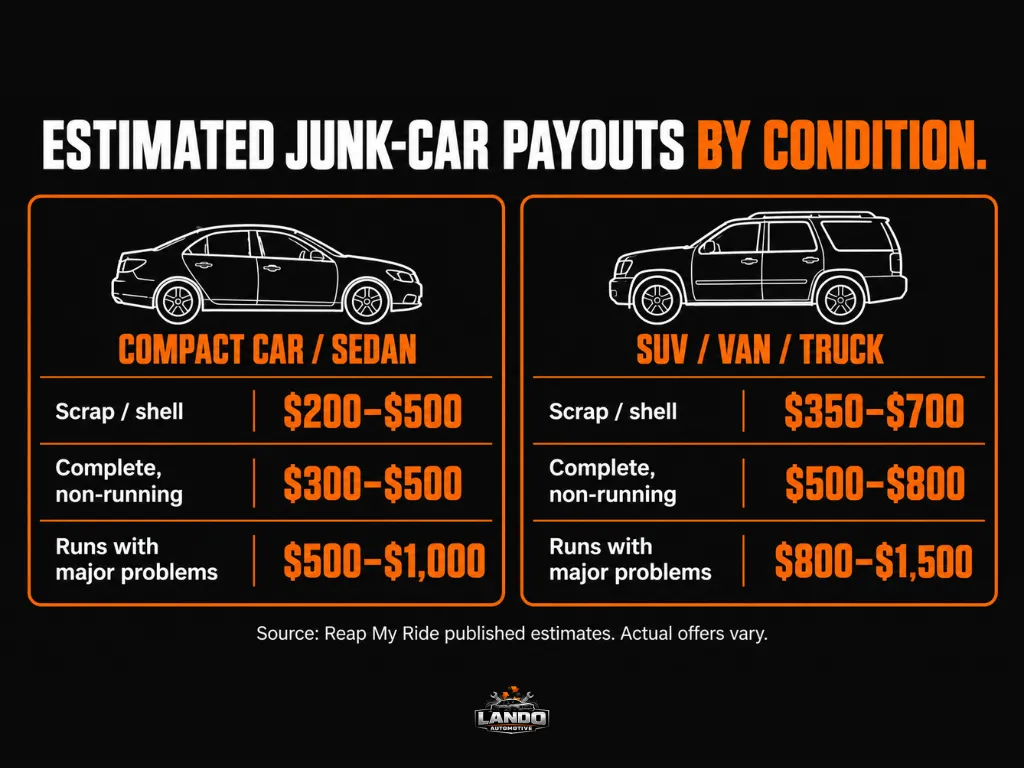
These differences reflect how buyers assess vehicle value. Scrap yards and junkyards may prioritize different materials and components, with some focusing on scrap metal and others paying more for reusable parts. Vehicle weight, completeness, and local demand also influence offers. Checking an estimated value with a scrap car value calculator provides a useful starting point before comparing quotes.
| Vehicle Category | Condition | Published Reap My Ride Range |
| Compact Car or Sedan | Scrap/shell | $200-$500 |
| Compact Car or Sedan | Complete, non-running | $300-$500 |
| Compact Car or Sedan | Runs with major problems | $500-$1,000 |
| SUV, Van or Truck | Scrap/shell | $350-$700 |
| SUV, Van or Truck | Complete, non-running | $500-$800 |
| SUV, Van or Truck | Runs with major problems | $800-$1,500 |
How a Junkyard Calculates Its Offer
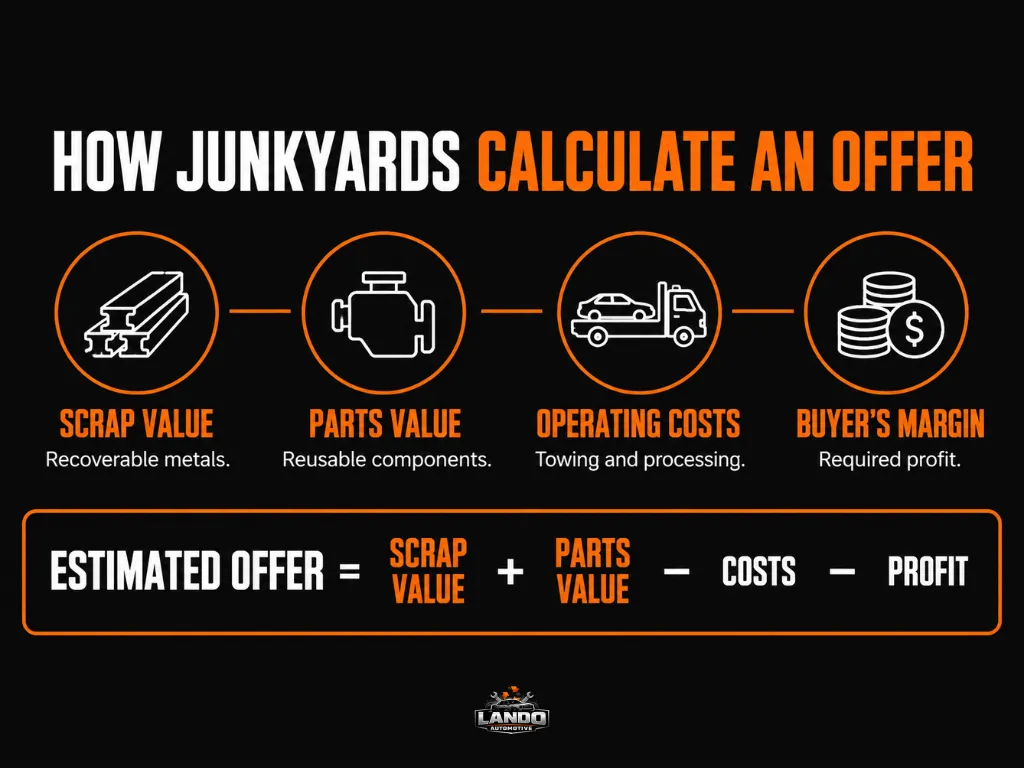
A junkyard estimates the resale value of a vehicle’s recoverable metals and reusable parts, then accounts for towing, dismantling, processing costs, and its required profit. The offer also depends on vehicle condition, local scrap prices, and demand for replacement parts.
A simplified formula explains how these factors influence the offer:
- Estimated offer = Recoverable scrap value + Reusable parts value − Operating costs − Desired profit
For example, a 3,000-pound sedan may contain valuable scrap metals alongside reusable components such as its engine, transmission, and catalytic converter. The buyer estimates what these materials and parts could sell for, avoids counting their value twice, and deducts expected expenses before making an offer.
Scrap weight and the steel rate
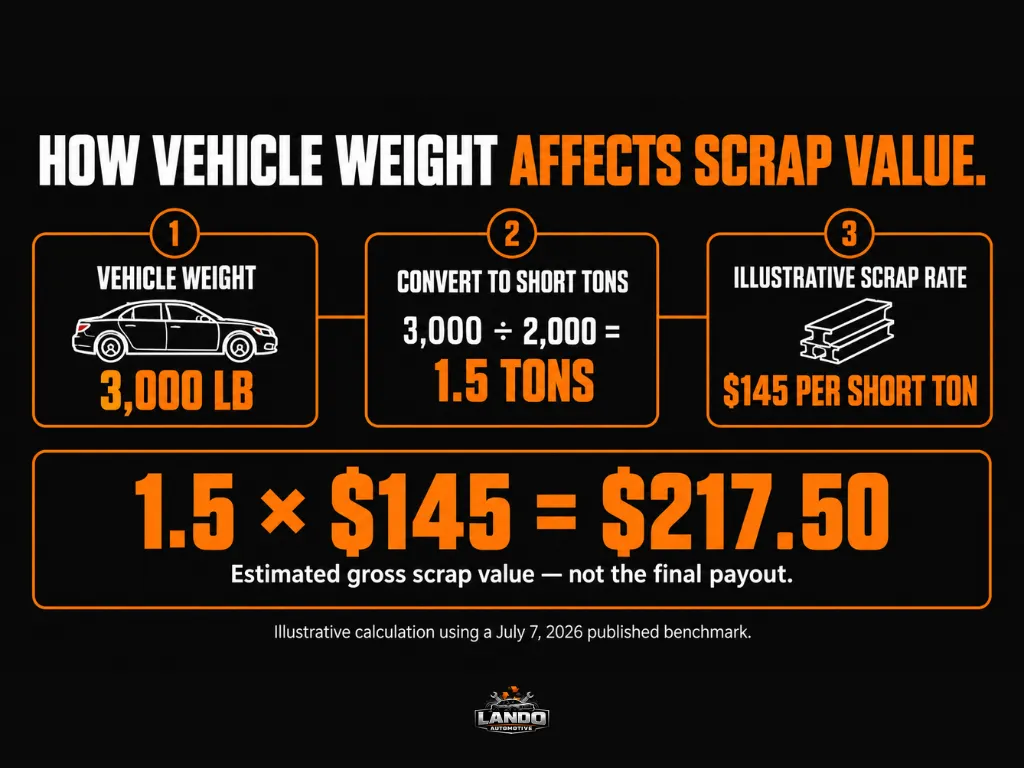
A rough whole-vehicle scrap estimate can be calculated by dividing the car’s weight in pounds by 2,000 and multiplying it by a comparable whole-car scrap rate per short ton. This is only an estimate: actual yard payouts also reflect recoverable materials, vehicle completeness, processing costs, and local pricing. Reap My Ride’s August 2025 example uses a 3,000-pound sedan at $170 per ton: 3,000 ÷ 2,000 = 1.5 tons, and 1.5 × $170 = $255.
For a published benchmark, ScrapMonster’s whole auto bodies price page lists $7.25 per hundredweight, equivalent to $145 per short ton, dated July 7, 2026. At that rate, a 3,000-pound vehicle has an estimated gross scrap value of $217.50 before buyer-specific deductions. This is a historical benchmark, not a verified October 2026 market quote.
Rates move, so quotes expire. Recycling Today’s RMDAS ferrous scrap reports show mill prices shifting by tens of dollars per ton in a single month, and our look at the vehicle recycling market covers what drives those swings. A number you heard last week may not hold today.
Parts value on top of scrap
Junkyards that resell used parts may offer more for vehicles with reusable engines, transmissions, catalytic converters, and aluminum wheels. Cash Auto Salvage estimates catalytic converter values at $150-$800 for many vehicles, with some exceeding $1,000. Actual prices depend on the vehicle model, component condition, precious-metal prices, and buyer demand.
Scrap-focused yards, however, prioritize recoverable materials over individual parts, making the recyclable metal content of a vehicle more relevant to their offers.
Costs the yard subtracts
Towing, labor, fluid disposal and the yard’s margin all come out of the offer. EPA’s end-of-life vehicle guide describes the fluid, battery and hazardous-material handling dismantlers must manage.
Towing costs vary by buyer. Some junkyards deduct transportation expenses from their offers, while Reap My Ride and Pull-A-Part advertise free vehicle pickup and towing. Confirm whether the quoted amount includes pickup before accepting it.
How Much Will a Junkyard Pay for a Running Car
Running cars generally receive higher junkyard offers than comparable non-running vehicles because their engines, transmissions, and other components may have greater resale value. Reap My Ride lists estimated payouts of $500-$5,000+ for running vehicles, including roadworthy cars, trucks, and SUVs. Actual offers depend on vehicle type, condition, and local demand.
A working engine can increase the offer, although running condition doesn’t guarantee mechanical reliability. Cash Auto Salvage estimates that a functioning engine can add $100-$400 compared with a similar non-running vehicle. The premium depends on mechanical condition and parts demand.
Cars that run but have major faults, such as a blown head gasket or slipping transmission, generally receive lower offers than mechanically sound vehicles. Buyers account for the risk that these components may need repairs or cannot be resold.
For clean, low-mileage, roadworthy vehicles, a private sale may bring more money than a junkyard offer. However, knowing when to get rid of a car also means weighing its resale value against repair costs and future maintenance expenses.
How Much Will a Junkyard Pay for a Truck
Junkyards may pay more for trucks than passenger cars because trucks often weigh more and contain valuable reusable parts. Their scrap value depends on vehicle weight and metal prices, while the engine, transmission, axles, and body panels may increase offers when resale demand is strong.
Truck size also affects potential payouts:
- Half-ton pickups (Ford F-150, Chevrolet Silverado 1500) – Offers depend on vehicle weight, mechanical condition, and demand for reusable drivetrain and body components.
- Three-quarter-ton and one-ton pickups (Ford F-250, Chevrolet Silverado 2500HD) – These heavier-duty trucks may command higher offers because of their greater weight and potentially valuable drivetrain components.
Parts that can increase a truck’s junkyard value include engines, transmissions, axles, aluminum wheels, reusable cab and bed panels, and diesel-specific components.
Estimated junkyard payouts for trucks
According to Reap My Ride’s February 2026 pricing estimates, payouts for SUVs, vans, and trucks vary by condition:
| Vehicle Condition | Estimated Payout |
| Scrap-condition or incomplete vehicle | $450-$700 |
| Complete, non-running vehicle | $500-$800 |
| Running vehicle with major mechanical problems | $800-$1,500 |
| Roadworthy vehicle without major mechanical problems | $1,500-$5,000+ |
These are company-reported marketplace estimates for SUVs, vans, and trucks combined, not guaranteed truck-specific junkyard payouts.
Weight can make a measurable difference. For example, a pickup weighing 2,000 pounds more than a sedan would have $145 more in calculated gross scrap value at an illustrative whole-vehicle rate of $145 per short ton. However, actual offers also account for recoverable materials, reusable parts, towing, processing costs, and buyer margins.
Parts and Conditions That Raise the Offer
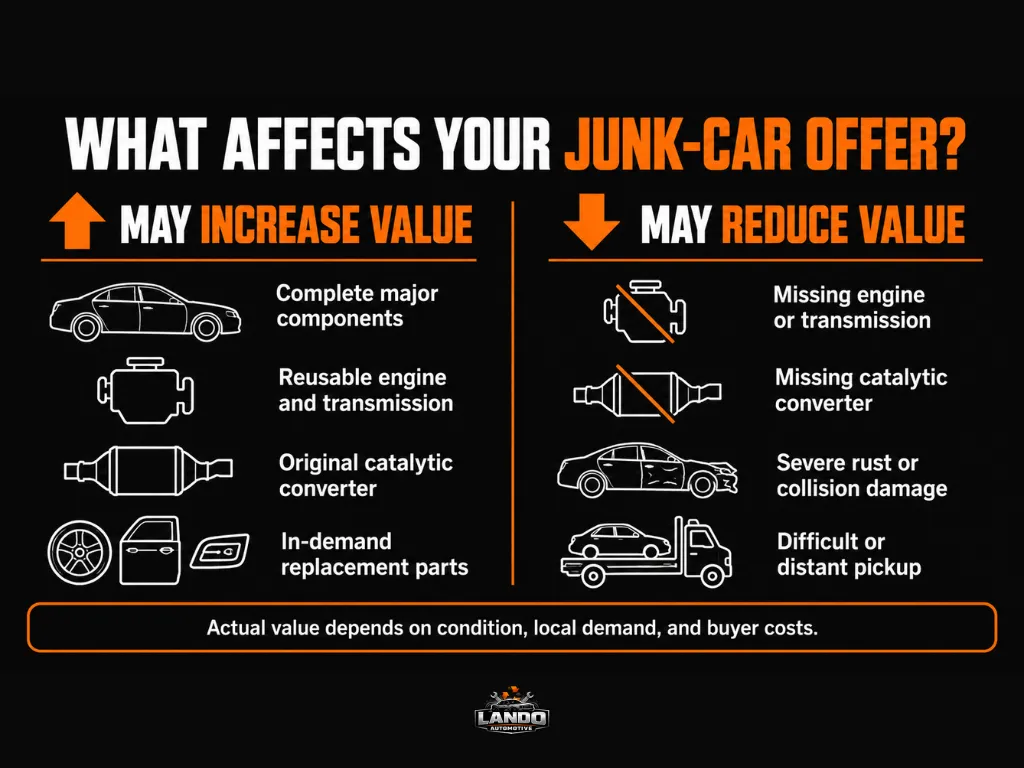
- Complete vehicle with all major parts – Yards pay for what they can resell or recycle.
- Original catalytic converter – Its precious-metal content can significantly increase the offer, particularly on certain hybrids and trucks.
- Newer models and high-demand vehicles – Cash Auto Salvage’s 2026 pricing guide identifies the Honda Civic, Toyota Camry, and Ford F-150 as high-demand models that may attract higher offers.
- Aluminum wheels and usable tires – These may add resale or scrap value, depending on their condition and local demand.
When you ask for a quote, list the year, make, model, mileage, running status and what’s still intact. Accurate details mean fewer price changes at pickup.
Missing Parts and Problems That Lower the Offer
Missing components, extensive damage, and transportation difficulties can reduce a junkyard’s offer. Ownership issues may also delay or prevent the sale, even when the vehicle has scrap value.
Missing catalytic converter
A missing catalytic converter can reduce the offer because it removes recoverable precious metals. Cash Auto Salvage identifies converters as a potentially valuable part of a junk vehicle, although their value varies by model, converter type, and metal prices.
Missing engine or transmission
Removing an engine or transmission eliminates potential resale parts and reduces the vehicle’s weight. The effect on the offer depends on the components’ condition and whether the buyer values them for reuse or scrap.
Stripped interior or missing wheels
Missing seats, electronics, and other reusable components may lower the offer. Vehicles without wheels can also be harder to load and transport, which may affect pickup arrangements or costs.
Heavy rust or collision damage
Severe rust and collision damage can make body panels and other components unsuitable for resale. However, damaged vehicles may still contain recoverable metals and usable parts, so the extent and location of the damage matter.
Distance and towing costs
Longer pickup distances can increase transportation expenses and reduce the amount a buyer is willing to pay. Even when towing is advertised as free, those expenses may already be factored into the initial offer.
Missing title or ownership issues
A missing title can delay or prevent a sale, although junking a car without a title may be possible with alternative ownership documents, depending on state requirements. For example, the California DMV describes circumstances in which other documentation may establish ownership.
An expired registration may complicate paperwork, while junking a vehicle with an outstanding lien generally requires addressing the lienholder’s legal interest before transfer.
Removing parts before scrapping
Selling parts separately can bring additional money, but removing them may also reduce the whole-vehicle offer. Compare both options before dismantling the car. Identifying what to remove before sending a car to a scrapyard can help distinguish personal belongings and removable accessories from components worth leaving intact.
Junkyard Payouts Compared With Other Buyers
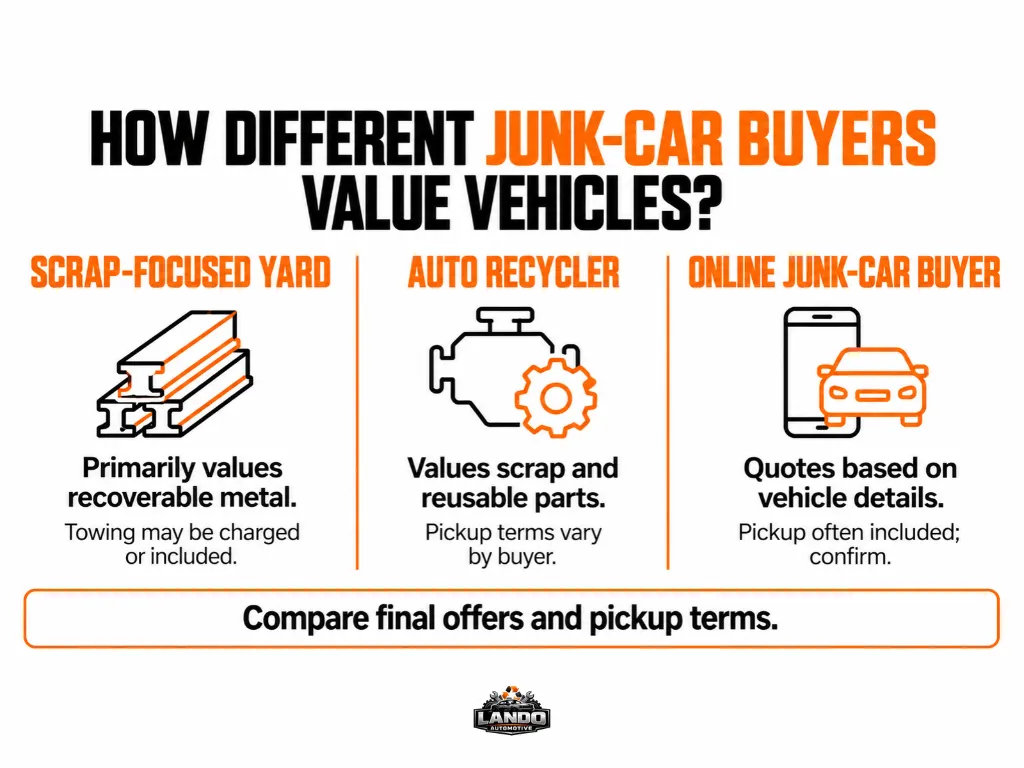
| Buyer Type | How the Offer Is Calculated | Towing |
| Scrap-Focused Yard | Primarily recoverable metal and vehicle weight | May be charged or included |
| Auto Recycler | Scrap value plus reusable parts demand | Depends on buyer |
| Online Junk-Car Buying Service | Quotes from a buyer or network based on vehicle details | Often included; confirm |
Auto recyclers may pay more for complete vehicles with valuable reusable parts, while scrap-focused yards primarily value recoverable materials. Online buying services simplify quote collection and pickup arrangements, although the final offer still depends on the individual buyer.
Quoted Price Versus Final Offer at Pickup
If you’re wondering how much will a junkyard give you for your car, remember that the initial quote isn’t always the final offer. Some junk car buyers may lower their offer at pickup if the vehicle’s condition, missing parts, or ownership documents differ from the original description. Any price adjustment should be explained before you agree to the sale.
Before accepting an offer, confirm:
- Price guarantee – Is the quoted amount fixed if the vehicle matches your description?
- Towing costs – Is pickup free, or will any fees be deducted?
- Final inspection – Can the driver change the offer after inspecting the vehicle?
You can estimate the car’s gross scrap value using its weight and a comparable local scrap rate, but this isn’t a guaranteed payout. Get the agreed price and pickup terms in writing, and confirm the typical timeline for junking a vehicle before scheduling collection. After the sale, check whether your state requires notifying the DMV to complete the necessary ownership or disposal paperwork.
Conclusion
How much will a junkyard pay for a car? There’s no fixed amount. While Pull-A-Part estimates $250-$500 for many junk vehicles, actual payouts depend on the vehicle’s condition, recoverable materials, reusable parts, and local demand.
A fair offer comes down to what buyers can recover from your vehicle and what they’re willing to pay for it. Comparing multiple quotes helps you identify a competitive price, while confirming the payment and towing terms ensures you know exactly how much you’ll receive.