
The electric vehicle battery recycling market is growing, but estimates of its size vary widely. Different research firms report significantly different figures, making it difficult to understand how large the industry really is. These differences can also make it harder to compare forecasts and identify meaningful growth opportunities. Much of this variation comes down to what each report includes and how the market is measured.
As electric vehicles become more common, battery recycling is attracting greater attention from manufacturers, investors, and regulators. This guide explores market size estimates for the U.S. and Europe, key industry trends, EU recycling targets, and the challenges shaping the industry’s future.
Electric Vehicle Battery Recycling Market Size and Forecasts
Market research firms report widely different estimates of the EV battery recycling market. The figures below come from their published summaries and reflect different research methods and market definitions rather than independently verified totals.
| Source | 2025 Market Size | Forecast | Stated CAGR |
| Fortune Business Insights | $0.59B | $3.26B by 2034 | 21.25% (2026-2034) |
| IMARC Group | $4.48B | $28.25B by 2034 | 22.01% (2026-2034) |
| Expert Market Research | $14.8B | $85B by 2035 | 23.5% (reported) |
| Technavio | Not disclosed | +$6.41B (2025-2030) | 44.8% (2025-2030) |
Why market size estimates vary
The differences begin with how each report defines the industry. Some focus more heavily on lithium-ion batteries, while others include established battery recycling activities. For example, lithium-ion batteries account for 93.21% of Fortune’s projected 2026 market, compared with 44.8% of IMARC’s 2025 estimate. IMARC also assigns 32.6% to lead-acid batteries.
Another difference is what researchers include in their calculations. Some reports cover production scrap alongside batteries reaching the end of their useful life. Others may account for recycling services or the value of recovered materials differently, although their public summaries don’t always explain these calculations.
These differences also appear in the broader vehicle recycling market, where estimates depend on whether researchers include reusable parts, recycled materials, and other related activities. Averaging figures based on different definitions would therefore produce a misleading market estimate.
Regional market distribution
Despite the differences in total market size, two major reports identify Asia Pacific as the largest regional market in 2025, followed by Europe and North America. According to Fortune’s regional estimates, Asia Pacific held 61.58% of the market, Europe 23.48%, and North America 10.98%. The report valued Europe’s market at approximately $140 million and North America’s at $60 million.
Meanwhile, IMARC’s regional breakdown assigns 50.5% to Asia Pacific, 21.3% to Europe, and 16.8% to North America. Both reports identify China as a major contributor to Asia Pacific’s leading position, supported by its large electric vehicle and battery manufacturing industries.
What the growth forecasts show
Although estimates differ considerably, the reports consistently predict strong market growth. However, the published figures deserve careful interpretation, particularly when comparing projected annual growth rates.
For example, the Expert Market Research forecast reports 23.5% annual growth from 2026 to 2035. However, its published market values imply approximately 19.1% annual growth over that period, suggesting an inconsistency in the forecast.
Likewise, Technavio’s forecast represents an expected increase rather than a total market valuation. Its report also separates manufacturing scrap from end-of-life batteries, with the production scrap segment valued at $497.4 million in 2024.
Overall, the forecasts point toward industry expansion, but there is no single agreed-upon market valuation. Each estimate should be presented with its source, year, and market definition to avoid misleading comparisons.
US Electric Vehicle Battery Recycling Market
The U.S. electric vehicle battery recycling market continues to develop as investment in recycling facilities grows. The market is projected to reach approximately $70 million in 2026, although this is one firm’s estimate rather than an agreed-upon figure.
Recycling capacity provides another measure of industry growth. The U.S. Department of Energy reported that facilities had the capacity to recover 35,500 tons of battery materials in 2023, with another 76,000 tons of annual capacity planned. Initial processing capacity was nearly 175,000 tons annually, with another 198,000 tons planned. These figures include manufacturing scrap and other batteries, not just retired EV batteries. They measure capacity, not actual recycled volumes.
Investment is also supporting expansion. In December 2024, American Battery Technology Company secured a $144 million federal grant for a planned facility with 100,000 tonnes of annual processing capacity. Meanwhile, Redwood Materials raised $425 million in January 2026, primarily for energy storage expansion. Its partnership with General Motors also supports battery reuse and recycling.
Challenges facing US battery recycling
Despite growing investment, four challenges remain:
- Battery collection – Gathering retired batteries from dealerships, repair shops, and the fragmented scrap yard and junkyard network is difficult
- Safe transportation – Damaged lithium-ion batteries pose fire risks and require special handling
- Processing capacity – Facilities require major investment and enough material to operate efficiently
- Battery supply – Manufacturing scrap remains important while many EV batteries are still in use
Ultimately, expanding recycling capacity only makes economic sense when enough recyclable material is available to support operations.
Europe Electric Vehicle Battery Recycling Market
Europe is the second-largest regional market for electric vehicle battery recycling, behind Asia Pacific. The European market was valued at $140 million in 2025 and is projected to reach $160 million in 2026. This represents 23.48% of the global market in 2025, although other estimates place Europe’s share at 21.3%.
European market growth and challenges
Europe’s recycling market is supported by growing demand for battery materials and the EU Battery Regulation, which sets mandatory recycling and material recovery targets. These requirements encourage investment in recycling facilities and technologies that recover lithium, nickel, cobalt, and other valuable materials.
However, battery supply remains a major challenge for European recyclers. Recycling capacity has expanded faster than the supply of batteries available for processing. Manufacturing scrap currently provides much of the material, while large volumes of retired EV batteries aren’t expected until the 2030s.
This creates a gap between planned recycling capacity and actual demand for recycling services. Europe’s long-term growth potential remains significant, but near-term expansion depends on securing enough battery material, improving processing capacity, and maintaining demand for recovered metals.
Electric Vehicle Battery Recycling Market Trends
Recycling capacity is outpacing battery supply
Recycling capacity has expanded faster than the supply of retired EV batteries. Manufacturing scrap remains the main source of recyclable battery materials, while large volumes of retired EV batteries are expected from the mid-2030s onward.
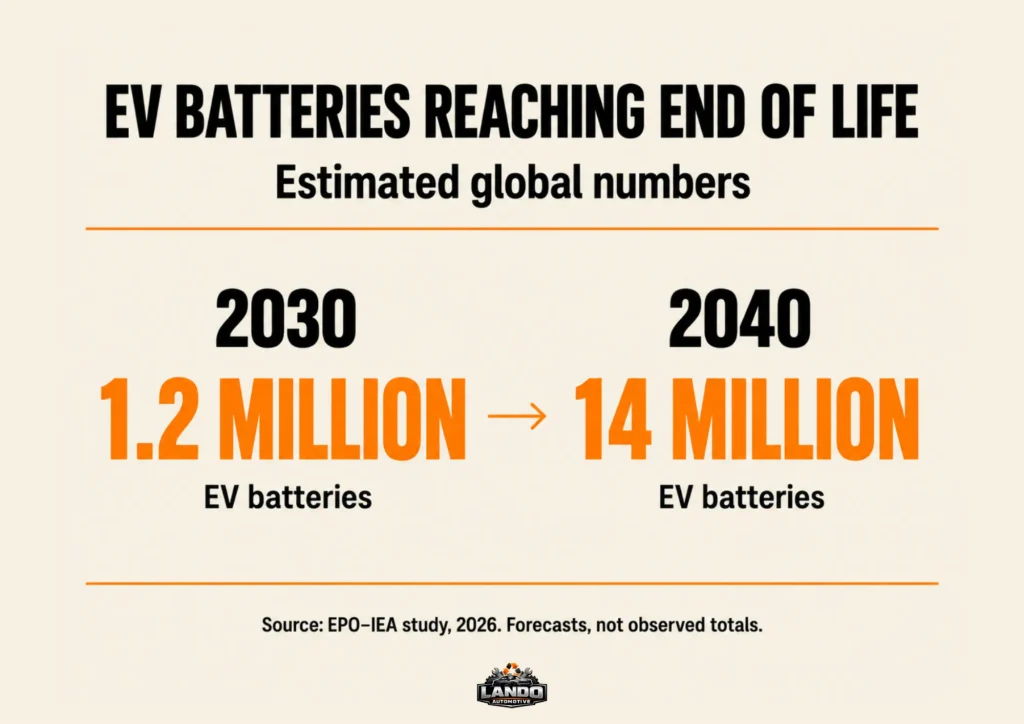
A joint EPO-IEA study estimates that around 1.2 million EV batteries could reach the end of their useful lives in 2030, rising to 14 million by 2040. This gap between current supply and future demand creates challenges for recyclers investing in new facilities.
LFP batteries are changing recycling economics
The growing use of lithium iron phosphate (LFP) batteries is changing recycling economics. Unlike nickel-based batteries, which contain valuable nickel and cobalt, LFP batteries generally offer lower recovered material value.
IEA’s recycling analysis states that this shift makes recycling less profitable when businesses depend mainly on selling recovered metals. Recyclers may need lower processing costs or service-based business models to handle increasing volumes of LFP batteries economically.
Battery recycling innovation is expanding
Research into battery recycling and reuse is growing rapidly. International patent families related to battery recycling, reuse, and recovery grew by an average of 42% annually between 2017 and 2023. This compares with 16% for rechargeable battery manufacturing and 2% across all technology fields.
Asian applicants accounted for 63% of these patent families in 2023, while European applicants represented approximately 20%. These figures indicate growing investment in technological development, although patents do not directly measure recycling revenue or commercial success.
Battery reuse can delay recycling
Not every EV battery reaches a recycler when it leaves a vehicle. Some batteries can be reused in other vehicles or repurposed for energy storage, extending their useful lives. For example, Redwood Materials’ partnership with General Motors includes repurposing retired EV batteries for stationary energy storage alongside recycling activities.
However, the IEA’s analysis highlights challenges such as safety requirements, uncertain remaining battery life, and falling prices for new batteries. Reuse can delay when batteries become available for recycling, making future material supply harder to predict.
How EV Battery Recycling Works
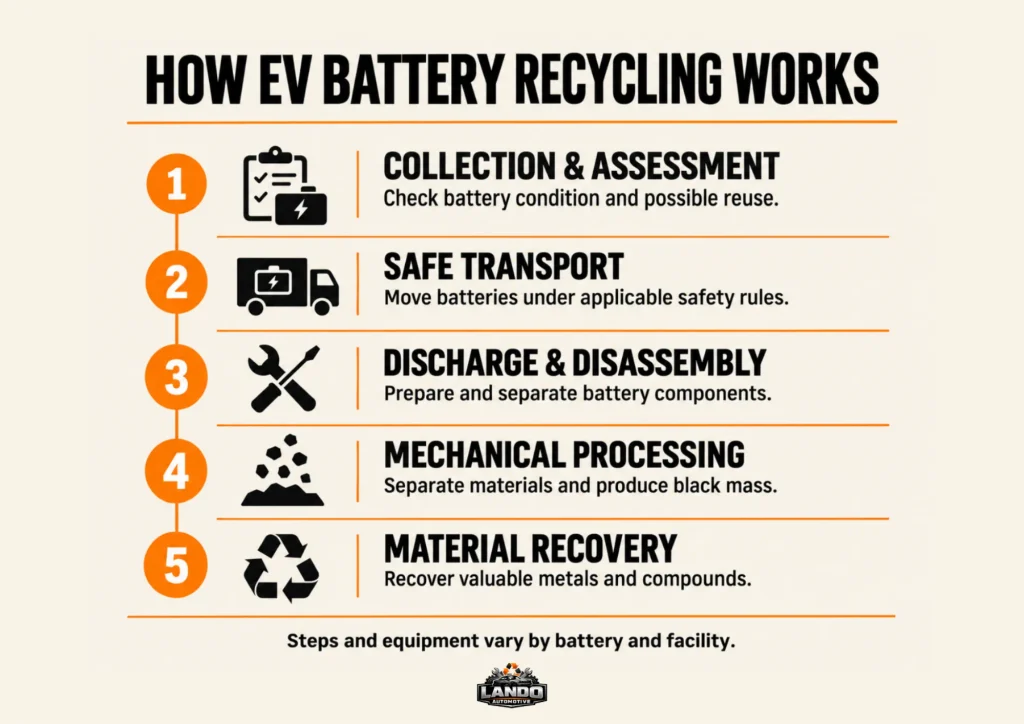
The process follows a broadly consistent sequence:
- Collection and assessment – Batteries are checked for damage and remaining capacity to determine whether they can be reused or recycled, similar to the process of junking a car.
- Safe transport – Certified handlers move batteries under hazardous-materials rules.
- Discharge and disassembly – Packs are discharged, then separated into modules and cells.
- Mechanical processing – Shredding and separation produce “black mass”, a powder rich in cathode and anode materials.
- Material recovery – Chemical or thermal processes extract metals and compounds for reuse.
Batteries are just one part of vehicle recycling. Understanding how much of a car can be recycled also helps put battery recovery into perspective alongside other materials recovered from end-of-life vehicles.
Three recovery approaches
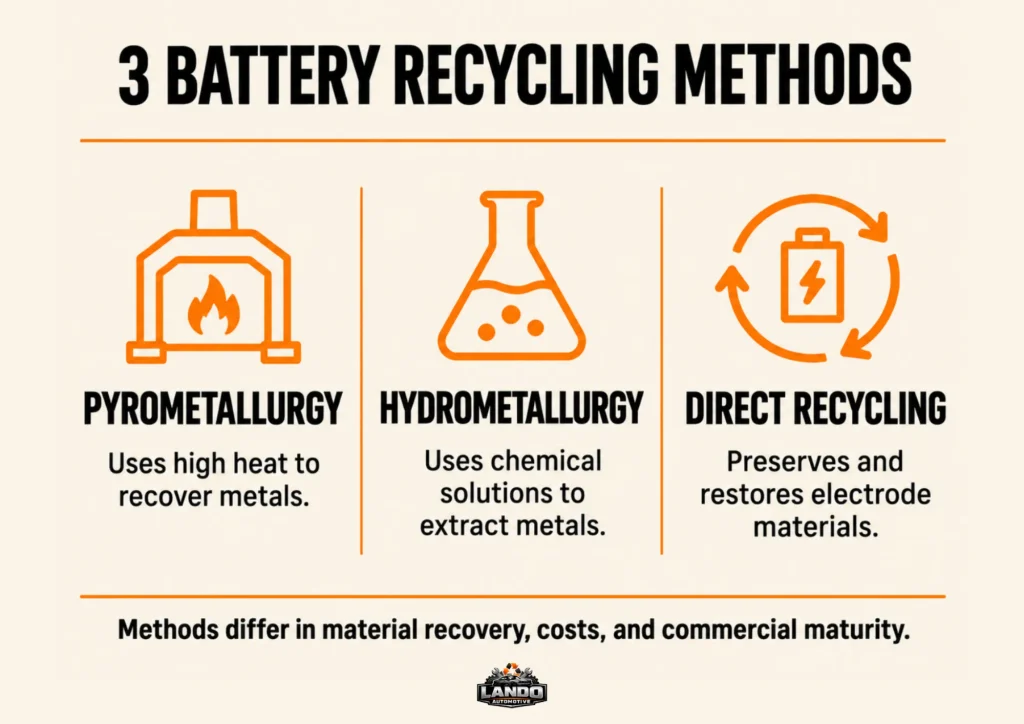
The three main battery recycling methods differ in how they recover materials, their costs, and their commercial readiness. The International Energy Agency (IEA) explains these differences.
| Method | How It Works | Advantages | Limitations |
| Pyrometallurgy | Uses high heat to recover metals | Handles mixed battery materials | High energy use; lithium recovery can be limited |
| Hydrometallurgy | Uses chemical solutions to extract metals | Can recover high-purity metals, including lithium | Requires chemicals, wastewater treatment, and careful processing |
| Direct Recycling | Preserves and restores battery electrode materials | Can save energy and retain material value | Less commercially established; requires suitable, well-separated materials |
No single method works best for every battery. The choice depends on battery chemistry, processing costs, and the materials being recovered. Some facilities combine methods, such as using high-temperature treatment followed by chemical processing to improve recovery.
What the Market Data Does, and Doesn’t Tell Us
Understanding the electric vehicle battery recycling market requires looking beyond revenue forecasts. Four key measures help explain how the industry is performing:
- Market revenue – The estimated value of recycling activities, depending on what each report includes
- Facility capacity – The amount of battery material a plant can process, not what it actually processes
- Battery supply – The material available for recycling, including manufacturing scrap and retired batteries
- Material recovery rates – The percentage of specific materials successfully recovered during recycling
These figures measure different things. A facility may have high processing capacity but receive too few batteries to operate efficiently. Similarly, strong recovery rates don’t guarantee profitability if operating costs are high.
What the numbers can and cannot prove
Market forecasts can indicate expected industry growth, but they cannot guarantee future revenue or profitability. Similarly, announced recycling capacity shows what facilities could process, not how much material they actually receive or recycle.
These limitations matter when comparing reports. Market estimates often use different definitions, while recycling capacity, battery supply, and recovery rates measure separate parts of the industry. A high figure in one category does not automatically indicate strong performance in another.
For a reliable assessment of the EV battery recycling market, compare figures from the same year and region, check what each source measures, and distinguish projections from actual results.
Conclusion
The electric vehicle battery recycling market is expanding, but its future depends on more than growing investment and recycling capacity. Limited battery supply, changing battery technologies, and processing costs continue to shape the industry. As more EVs reach the end of their useful lives, efficient recycling will become increasingly important for recovering valuable materials.
While battery recycling is one part of the process, responsible vehicle disposal goes much further. If you have an old, damaged, or unwanted vehicle, Lando Automotive can help you turn it into cash. Get in touch today to explore your options and receive an offer for your car.