
That old sedan sitting in a junkyard isn’t as done as it looks. Its engine might end up in another driveway. Its steel could become part of a new vehicle within months. So how much of a car can be recycled, exactly? The answer surprises most people, and it’s rarely just “the metal parts”.
Below, we’ll break down what actually happens once a vehicle reaches the end of its road. You’ll learn which parts get reused, which get shredded down to raw material, and which pieces still end up as waste no matter how advanced the process gets. By the end, you’ll know exactly what recovery looks like, part by part, stage by stage.
How Much of a Vehicle Can Be Recycled?
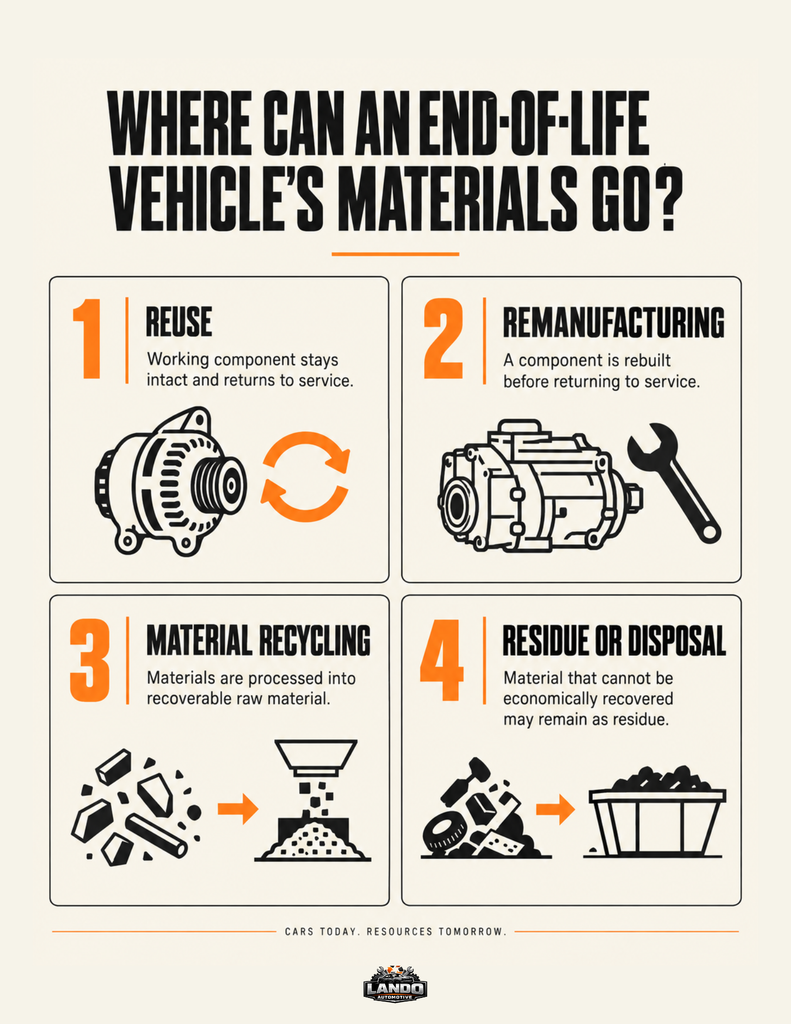
Determining how much of a car can be recycled comes down to its age, condition, material mix, and the capabilities of the local recycler. In practice, an end-of-life vehicle typically moves through four main recovery outcomes:
- Reuse – A working component is pulled intact and sold or installed in another vehicle as-is.
- Remanufacturing – A component is rebuilt to like-new spec and returned to service.
- Material recycling – Parts that can’t be reused are broken down into raw materials (steel, aluminum, copper, glass) for manufacturing.
- Residue or disposal – Mixed material that can’t be economically separated or recovered.
Metals dominate those first three categories. Steel and iron alone typically account for the largest recoverable share of a car’s total weight, which is why recycled automotive steel is one of the most valuable commodities the process produces. Everything else, like plastics, glass, rubber, and foam, recycles at lower rates because it’s harder and more expensive to separate cleanly.
What Parts of a Car Can Be Recycled?
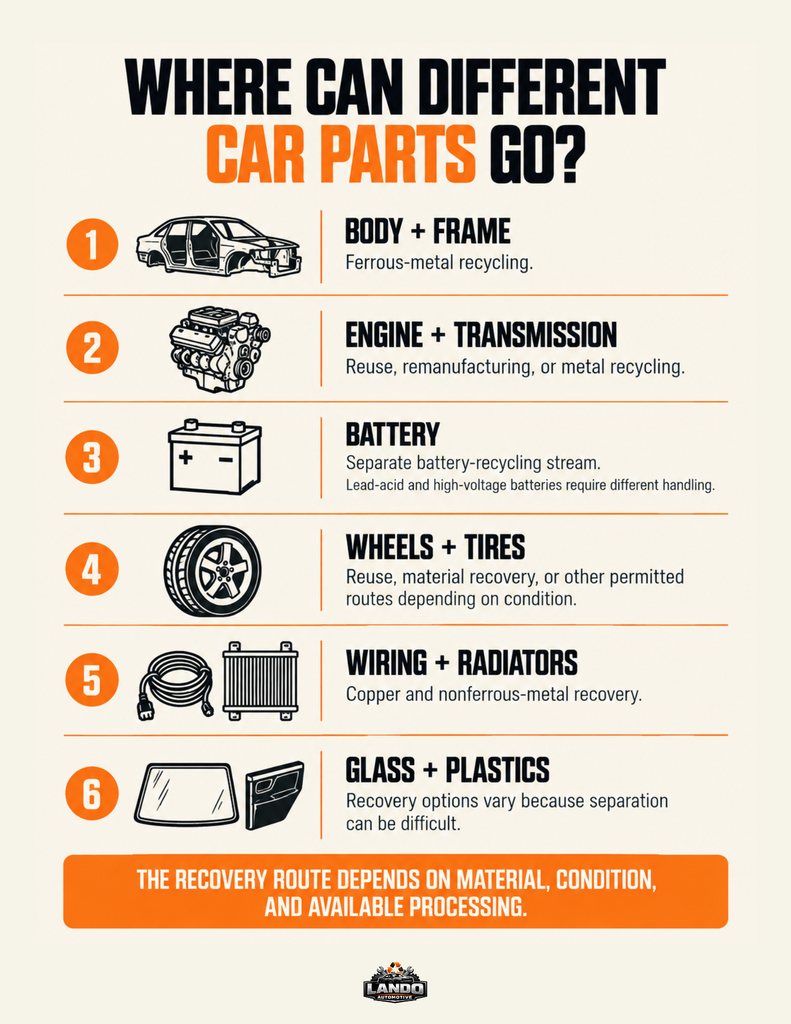
Almost every system in a vehicle has some recovery path, but the destination and difficulty vary widely by part.
| Part or Material | Typical Destination | Important Limitation |
| Body and frame | Ferrous-metal recycling | Coatings and attached materials must be separated first |
| Aluminum components | Nonferrous-metal recycling | Must be separated from steel and mixed alloys |
| Engine and transmission | Reuse, remanufacturing, or metal recycling | Depends on condition and local parts demand |
| Catalytic converter | Specialized metals recovery | Should stay with the vehicle unless the buyer approves removal |
| Wiring and radiators | Copper and nonferrous-metal recovery | Labor-intensive; contamination reduces yield |
| Battery | Separate battery-recycling stream | Lead-acid and high-voltage batteries need different handling |
| Wheels | Reuse or metal recycling | Material and condition determine the route |
| Tires | Reuse, retreading, material recovery, or permitted disposal | Options vary by condition and local infrastructure |
| Glass | Specialized glass processing | Laminated windshields are harder to process |
| Plastics and upholstery | Component reuse or limited material recovery | Mixed resins, foam, adhesives, and contamination create difficulties |
The pattern here is consistent across nearly every part: metal recycles cleanly and profitably, while anything mixed-material (plastic, foam, laminated glass) is technically recyclable but economically harder to process.
What Happens Before a Car Is Crushed?
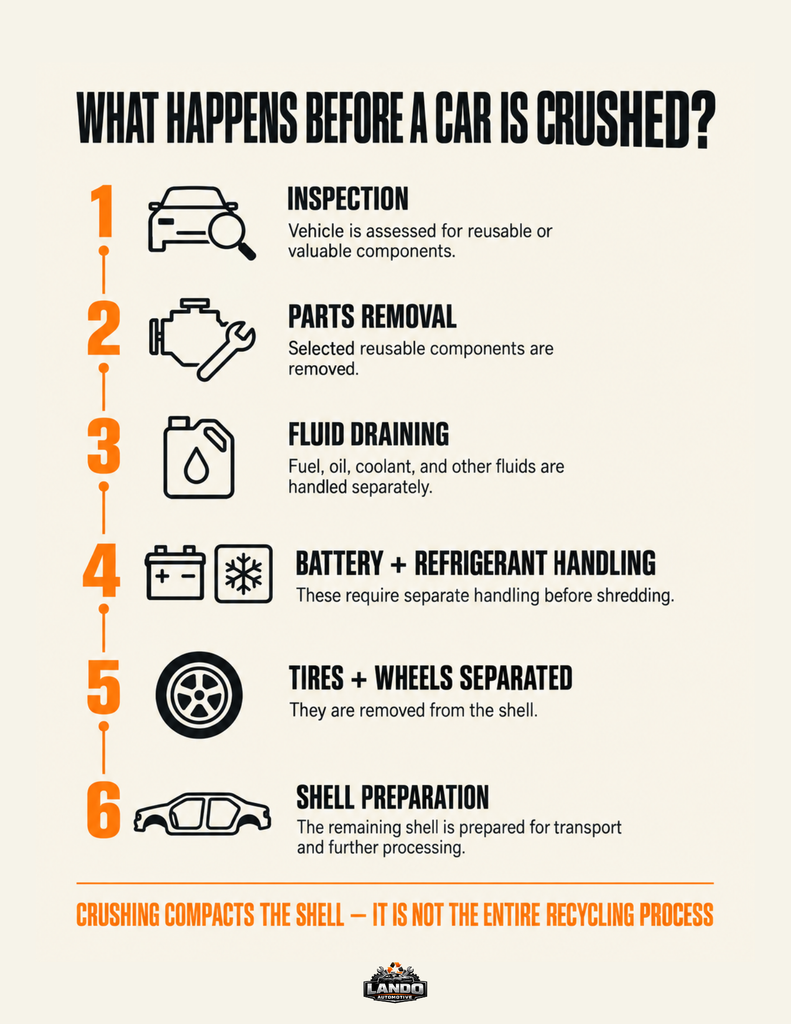
Crushing happens near the end of the recycling process, after the vehicle has already been inspected and stripped of materials that can be reused, recycled, or handled separately. Understanding what happens when you junk a car helps explain why a junk vehicle does not usually go straight from pickup to the crusher.
The process typically starts with an inspection for reusable or valuable parts. Engines, transmissions, doors, catalytic converters, electronics, and other components may be removed before the remaining shell is processed.
Fluids such as fuel, engine oil, transmission fluid, and coolant are then drained and handled separately. Batteries, refrigerants, tires, and wheels are also removed because they follow different recycling or disposal processes. How carefully these steps are handled can depend on the recycler, which is one reason choosing a car junking company is an important part of the process.
Once reusable parts, fluids, and other materials have been removed, the stripped vehicle body can be crushed or baled. Compacting the shell reduces its size, making it easier and more economical to transport to a shredding or metal-processing facility.
How Do They Recycle Crushed Cars?
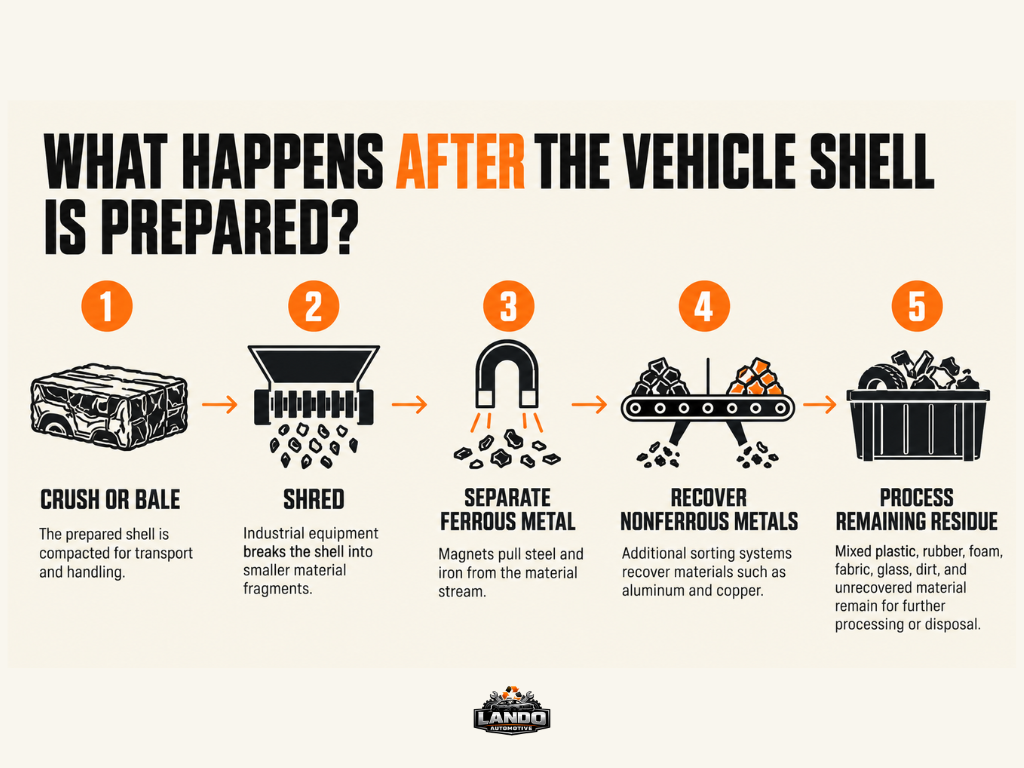
Once a vehicle’s shell has been stripped and crushed, the real material-recovery process begins.
Crushing or baling
Compacting the shell reduces its size dramatically, which cuts transportation and storage costs before it reaches a shredding facility.
Shredding the vehicle
The compacted shell is fed into industrial shredding equipment that tears it into smaller, uniform fragments, a mix of metal, plastic, glass, rubber, and foam all mixed together.
Separating ferrous metals
Powerful magnets pull steel and iron out of the shredded stream. Because ferrous metal makes up the largest share of a car’s weight, this step alone recovers most of the vehicle’s material value.
Recovering nonferrous metals
What’s left still contains aluminum, copper, and other valuable metals. Facilities use eddy-current separators, density sorting, air classification, and sensor-based systems to pull these out for separate processing.
Processing Automotive Shredder Residue (ASR)
What remains after metal recovery is a mixed leftover of plastic, rubber, foam, fabric, glass, dirt, and small amounts of metal that escaped the earlier separation steps. Some advanced facilities run additional recovery passes on this residue; the rest typically goes to disposal, which is the main reason recycling rates fall short of 100%.
Which Car Materials Are Hardest to Recycle?
Not everything in a car recycles at the same rate, even when it’s technically possible. The most persistent problem materials include:
- Laminated windshields – The plastic interlayer that keeps glass from shattering also makes it difficult to separate from the glass itself.
- Mixed or unidentified plastics – Dozens of resin types across a single vehicle, often without clear labeling.
- Bonded composite materials – Parts fused from multiple materials that can’t be pulled apart cleanly.
- Contaminated foam and upholstery – Seat foam and fabric soaked in fluids or mixed with adhesives.
- Complex electronic assemblies – Sensors, control modules, and wiring harnesses with embedded circuitry.
- Adhesives and coatings – Paint, undercoating, and sealants that contaminate the metal or plastic underneath.
The key distinction worth understanding: something being technically recyclable isn’t the same as it having an economical, accessible recycling stream near you. A material can be chemically recoverable and still end up as residue simply because no nearby facility can process it profitably.
Does Every Junk Car Follow the Same Recycling Path?
No. The vehicle recycling path depends first on the vehicle’s condition and how complete it is. An intact car may yield more reusable parts, while a stripped, contaminated, or fire-damaged vehicle usually has fewer recovery options.
Local demand also matters. Common models with usable components may be dismantled more extensively before shredding, while vehicles with little resale value move through the process faster.
Drivetrain type and regional infrastructure can change the path as well. Gas, hybrid, and electric vehicles require different handling, especially for batteries, and not every area has specialist facilities for glass, electronics, or high-voltage battery recovery.
Should You Remove Parts Before Recycling Your Car?
If you’re planning to sell a junk car, it’s usually best to leave major components in place. Removing the engine, catalytic converter, battery, wheels, or other valuable parts can reduce the vehicle’s value and may also affect whether the buyer can pick it up as expected.
Personal belongings should always be removed, but dismantling the vehicle is different. If you’re unsure what to remove from a car before scrapping, check the buyer’s requirements before taking out anything beyond your own possessions.
The same applies when learning how to junk a car. Before making changes to the vehicle, confirm what paperwork is required, what condition the buyer expects it to be in, and whether missing parts could affect the offer or pickup.
Final Takeaway
At the end of the day, how much of a car can be recycled comes down to metal, mostly, and that’s the good news. Steel, aluminum, and copper recover cleanly and profitably, which is why a huge share of every vehicle’s weight avoids the landfill entirely. The tougher materials, like laminated glass or mixed plastics, are the real limiting factor, not a lack of willingness to recycle them.
Whether you’re selling a junk car or just curious about where old vehicles end up, the takeaway is the same: most of that car has value long after it stops running. With the right recycler and a little patience, far more gets recovered than most people expect.