
Every year, somewhere between 12 and 15 million vehicles reach the end of the road in the United States, roughly one out of every 20 cars registered nationwide. If yours is one of them, the good news is that junking a car has never been simpler, and doing it right can put real cash in your pocket instead of a rusting eyesore in your driveway.
This guide walks through exactly how to junk a car, from figuring out whether your vehicle even qualifies to what happens after the tow truck drives away. Whether you’re weighing how to scrap a car that won’t start or just looking for the fastest way to get rid of a junk car taking up space, selling a junk car for cash can be a straightforward option.
Signs Your Car Qualifies as a Junk Car
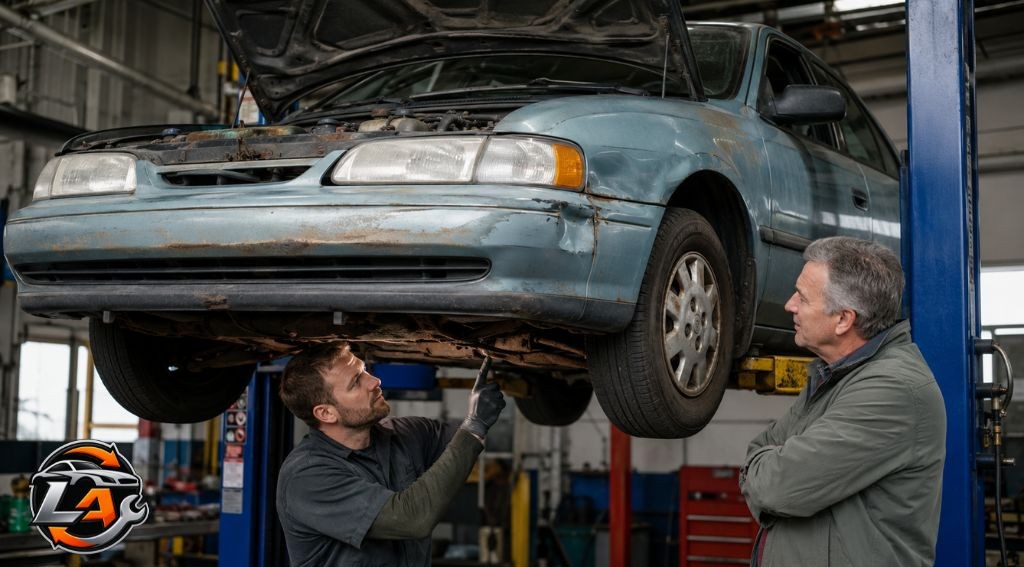
An old or damaged vehicle is not automatically a junk car. The real test is mathematical, not emotional, when a car is no longer worth repairing often comes down to whether the cost of repairs exceeds the vehicle’s actual value. If a $2,500 transmission repair is required for a car worth only $1,800, that vehicle has officially crossed the line from needing work to being junk.
A few mechanical red flags typically confirm it:
- The car won’t start or run reliably
- Frame or structural damage from a major collision
- Failed emissions or safety inspection with repairs that don’t pencil out
- Rust that’s compromised the body or undercarriage
- High mileage combined with a cascade of aging parts (transmission, engine, electrical system)
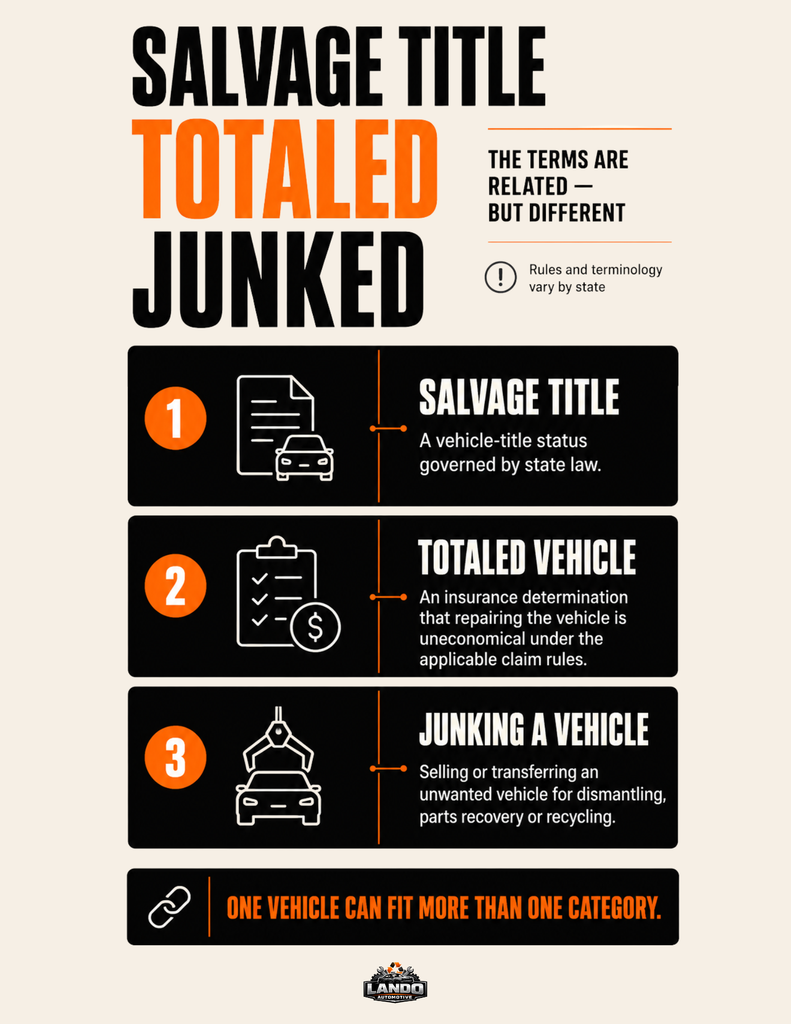
Insurance and junkyard terms are related but distinct. A salvage title is a legal DMV status given when repair costs approach a vehicle’s value, while a totaled car is an insurance declaration that a vehicle is uneconomical to fix. In contrast, junking is simply the final act of selling any vehicle, regardless of its title status, to a buyer who will scrap, recycle, or part it out.
How to Junk a Car
The process is fairly straightforward, but taking the right steps can help you get a better price and avoid paperwork problems.
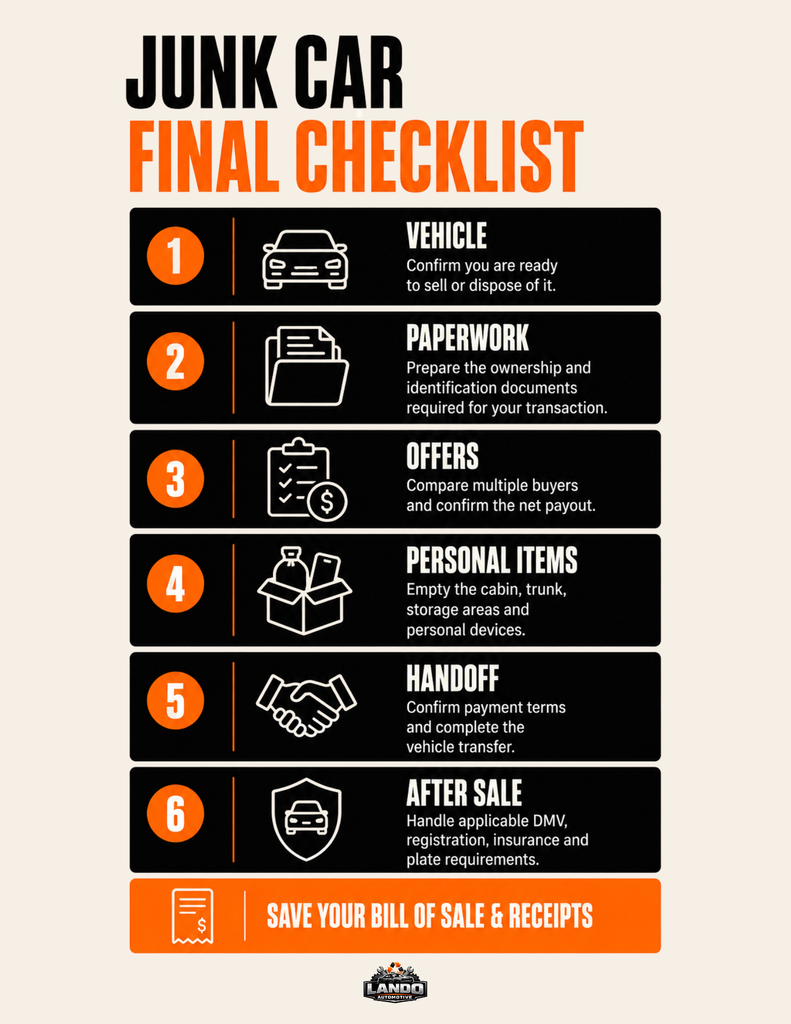
- Confirm the car qualifies – Decide whether the vehicle is no longer worth repairing or you simply want to get rid of it.
- Gather your paperwork – Have the title, registration, and ID ready.
- Get multiple quotes – Compare offers from junkyards, scrap buyers, and online car removal services.
- Clear out the car – Remove personal belongings, valuable parts, and any digital devices or stored information.
- Hand over the vehicle – Complete the sale, transfer the vehicle, and collect your payment.
- Complete the after sale paperwork – Cancel the registration and insurance and handle the plates according to your state’s requirements.
What You Need Before You Junk a Car
In most cases, you will need three basic documents to junk a car. The title serves as your primary proof of ownership, while your current registration and a valid government-issued photo ID help verify the vehicle and seller.
Requirements vary by state, so check with your buyer or state DMV before pickup. Some states may also require a notarized bill of sale or release of liability form, but the title, registration, and ID are the usual baseline.
Junking a car without a title
Losing the title doesn’t always prevent you from junking a car without a title. Some states allow junkyards and scrap buyers to purchase older vehicles without a title, particularly when the car is being sold for parts or scrap. Abandoned or inherited vehicles may also qualify under specific state rules if you can document ownership.
Check your state DMV or the buyer beforehand to confirm which documents are required. You may need your registration and photo ID, along with a notarized ownership affidavit or other documentation. If you prefer a simpler option, you can usually request a duplicate title from the DMV before selling the car.
Junkyard vs. Other Ways to Get Rid of a Junk Car
Junkyards aren’t the only path. Here’s how the main options stack up:
| Option | Payout Speed | Typical Payout | Effort Required | Paperwork Burden |
| Junkyard / scrap yard | Same day to a few days | Low–moderate (scrap/weight-based) | Low | Low-moderate |
| Online junk car buyer | 24-72 hours, cash on pickup | Moderate (competitive quotes) | Very low | Low (buyer often handles it) |
| Private sale | Days to weeks | Highest, if you find a buyer | High (listing, showings, negotiating) | Moderate-high (you handle title transfer) |
| Donation | Days to weeks (pickup scheduled) | None (tax deduction instead) | Low | Moderate (deduction paperwork) |
When each makes sense
If your priority is getting the car gone today, a local junkyard is usually the fastest option, and how quickly the sale can be completed depends on the buyer, paperwork, and pickup availability. For a balance of convenience and payout, an online junk car buyer can be a better choice because you can compare offers without handling the legwork yourself. If the car still runs and you have more time, a private sale may bring in more money. For those who prefer a tax benefit over cash, donating the vehicle can be the better fit.
Removing Valuable Parts Before You Sell
Before handing over the car, it can be worth reviewing what to remove before handing over the car, particularly smaller items that are easy to reuse or sell separately. A battery may be worth $10 to $30 on its own, while tires with decent tread and aftermarket electronics or stereo equipment may also have resale value.
The bigger mistake is removing major components such as the engine, transmission, or catalytic converter before getting a whole car quote. Buyers often price the vehicle assuming these parts are still intact, so removing them can reduce the offer by more than you would make selling the parts separately.
Parting out the car yourself can bring in more money in theory, but it requires time, storage space, and individual buyers for each part. For most sellers, the extra work isn’t worth the tradeoff compared with a straightforward whole-car sale.
Personal Data and Belongings to Clear Out
Clearing out personal data and belongings is a critical step that owners skip more often than you would think. This process matters for major security reasons, well beyond just leaving your sunglasses behind.
Physical items to check
- Glovebox and center console
- Trunk and spare tire well
- Under and between the seats
- Visors (people tape cash, garage door openers, and cards up there constantly)
Digital items to check
- GPS units with saved home/work addresses
- OBD-II recorders or dash cams
- Paired USB drives
- Bluetooth pairings and paired phones in the infotainment system; delete your device from the car’s memory, not just the other way around
Modern vehicles store a surprising amount of personal data that can be used for identity theft. This includes saved navigation addresses, phone contacts synced via Bluetooth, programmed garage codes, and old insurance documents in the glovebox. Taking just five minutes to clear out these items and wipe the digital data before vehicle pickup completely closes that security loophole.
Getting and Comparing Offers
Don’t take the first number you hear. Call at least two or three buyers, like junkyards, online buyers, and a private-sale estimate if the car still runs. Give each one the same information – year, make, model, mileage, running condition, and any known damage.
Disclose upfront, even the unflattering stuff. Buyers adjust their offer based on condition regardless, and disclosing early avoids a lowball renegotiation once the tow truck is already at your curb.
Watch for two red flags
When evaluating a buyer, pay close attention to how they handle the offer and describe your vehicle. Same-day pressure tactics are a concern when someone pushes you to accept an offer immediately before you have time to contact other buyers. “It’s basically worthless” framing can also be a scare tactic used to justify a low offer, particularly when the car still has an intact engine and transmission.
A legitimate buyer should be willing to give you a firm quote and let you take at least a day or two to consider it.
What Happens to the Car After You Junk It
Once your car changes hands, what happens after you sell it follows a fairly standardized recycling pipeline:
- Depollution – Fluids like oil, coolant, and refrigerant are drained and disposed of safely, along with the battery.
- Parts harvesting – Usable components (alternators, doors, mirrors, engines, transmissions) are pulled, tested, and resold to repair shops and DIY buyers.
- Shredding and scrap recovery – The remaining shell is crushed and shredded, and the metal is sold as scrap, which is eventually melted down into new steel products.
According to the EPA, more than 10 million vehicles are sent to salvage yards and scrap facilities in the U.S. each year, and roughly three-quarters of a typical car’s weight is recovered as recyclable metal. That makes the auto recycling industry one of the largest recycling sectors in the country by volume. The scale of vehicle recycling extends well beyond the United States, with millions of cars scrapped each year worldwide. Junking your car isn’t just decluttering your driveway; it’s feeding a genuinely large-scale materials recovery system.
Paperwork to File After the Sale
The sale isn’t fully complete until you finish the required paperwork. File a release of liability with your state DMV, if required, to avoid responsibility for anything that happens with the vehicle after it leaves your possession. Many states allow you to complete this online.
You should also cancel the registration and insurance policy. If you paid your insurance premium in advance, ask whether you are eligible for a prorated refund. Depending on your state’s rules, you may also need to return or transfer the license plates.
Finally, keep copies of the bill of sale and any receipts. These records can help resolve any paperwork or ownership questions that come up later.
Common Mistakes That Lower Your Payout
- Accepting the first offer – Always get multiple quotes, as even a second offer can reveal a significantly higher price.
- Waiting too long to sell – More time can mean additional rust, theft risk, and a lower eventual offer.
- Removing too many parts – Major missing components can reduce the whole car offer by more than the parts are worth individually.
- Not confirming free towing – Some buyers subtract towing fees from the advertised price, so confirm the net payout in writing before agreeing.
Conclusion
Learning how to junk a car really comes down to three things: knowing when your vehicle qualifies, having the right paperwork in hand, and comparing offers instead of settling for the first one you get. Follow the steps above, and you’ll walk away with more cash, less hassle, and one less eyesore taking up space – while the vehicle itself gets a second life through parts recovery and metal recycling. Whether you’re weighing how to scrap a car that’s been sitting for years or how to get rid of a junk car fast, the process above will get you there cleanly and profitably.