
That old sedan in the driveway has been sitting for months now, tires flat, plates expired. Maybe you’re wondering how many junk cars can you have on your property before someone calls the city. It’s a fair question, and most people assume there’s a clean answer, a number written somewhere in a rulebook.
There isn’t. In this guide, we’ll break down what actually determines whether your car crosses the line, including visibility, condition, and how long it’s been sitting. You’ll learn what Chicago, Illinois, and Indiana codes really say, and what tends to trigger a violation notice in the first place.
How Many Junk Cars Can You Have on Your Property?
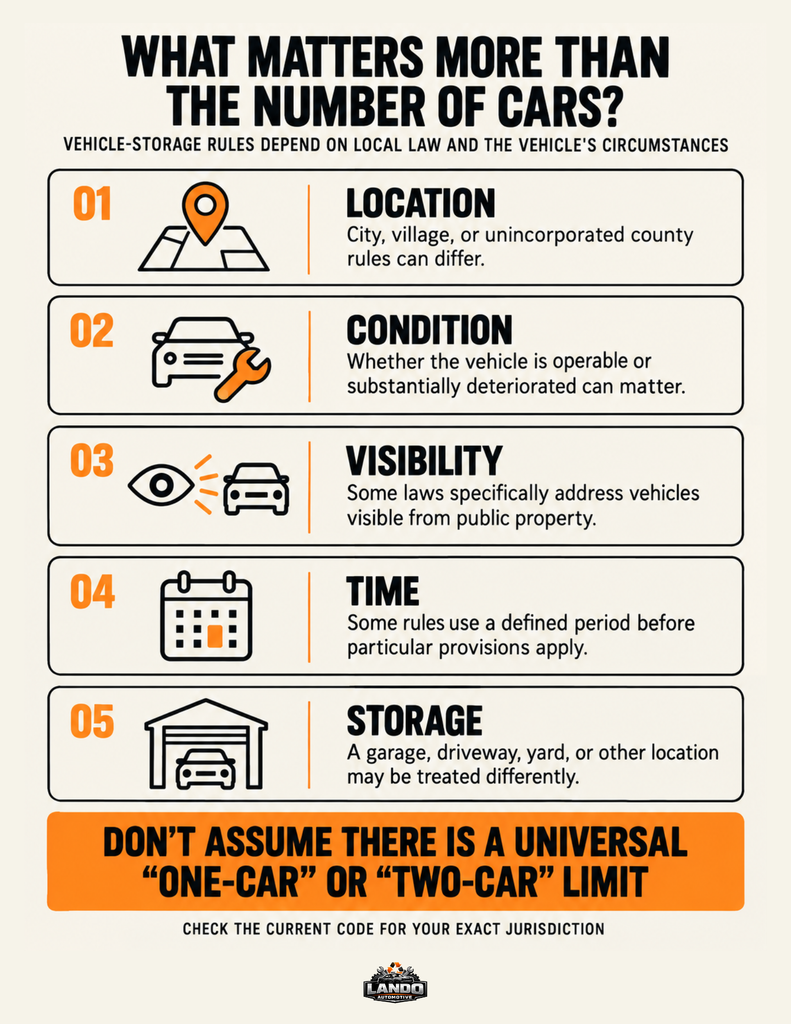
Most articles on this topic throw out a flat number, “one” or “two”, without a source. In reality, the number of junk cars you can have on private property depends on local regulations and factors such as zoning, property type, and how the vehicles are stored. Local authorities may consider several factors when determining whether a junk vehicle is allowed on your property, including:
- The city, village, or unincorporated county you live in, since vehicle-storage rules are set locally, not by a single federal or even statewide standard
- Whether the vehicle is operable under its own power
- Whether it’s visible from the street, a sidewalk, or a neighboring property
- How long it has remained in that condition or location
- Whether it’s stored inside a garage or other enclosed structure
- Zoning – residential, commercial, or automotive-use zones often carry different rules
That means the same car, say, a non-running sedan in a driveway, could be perfectly legal in one town and a citable violation two miles away. Before you assume you’re covered because you “only have one”, check your local code. That’s the only number that matters.
What Counts as a Junk or Inoperable Vehicle?
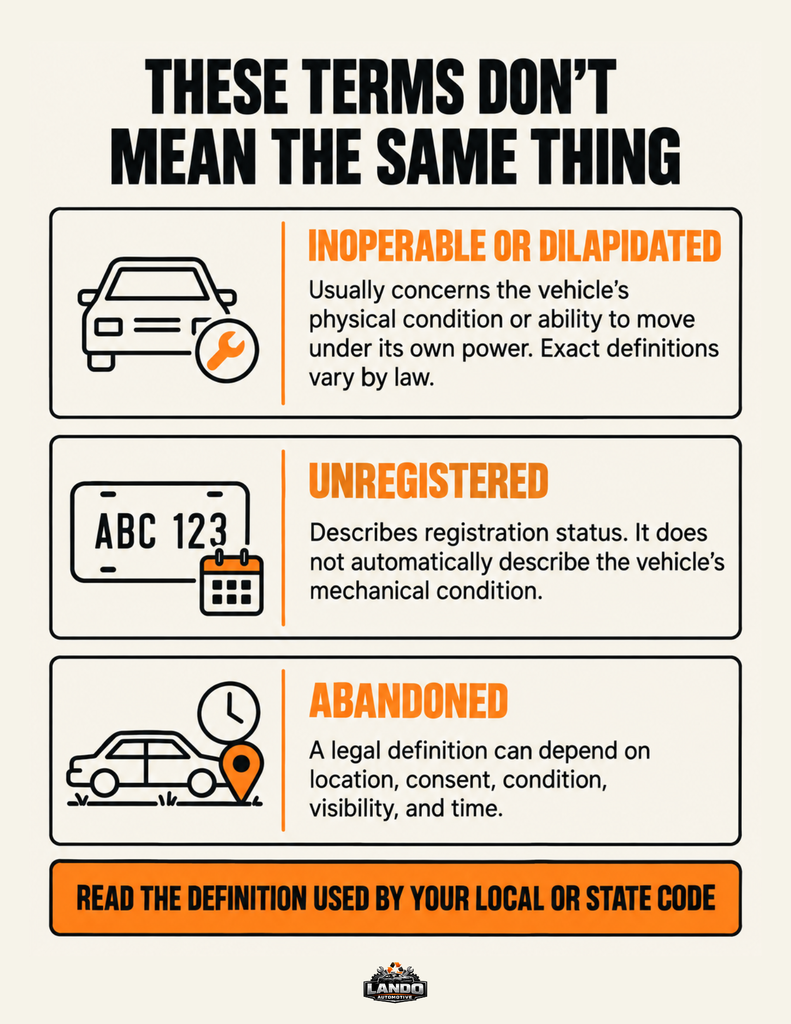
People use “junk”, “unregistered”, and “abandoned” interchangeably, but municipal codes don’t. Mixing them up is how homeowners misjudge their own risk.
Junk or inoperable vehicle
A vehicle typically qualifies as junk or inoperable if it’s missing major components, has sustained significant damage, or simply can’t move under its own power. The exact threshold, like how much damage or how many missing parts, is defined locally, not universally.
Unregistered vehicle
An expired tag doesn’t automatically make a car “junk”. An unregistered vehicle can be perfectly drivable. That said, many local codes independently restrict where unregistered vehicles can be stored, meaning a car can be street-legal-adjacent and still violate a storage ordinance.
Abandoned vehicle
Simply owning and intentionally keeping a car on your own land doesn’t make it “abandoned” in the legal sense. Abandonment definitions typically hinge on factors like location, whether the property owner consented to it being there, how long it’s remained, and whether it appears deserted, not just that it’s old or non-running.
Chicago Rules for Junk Cars on Private Property
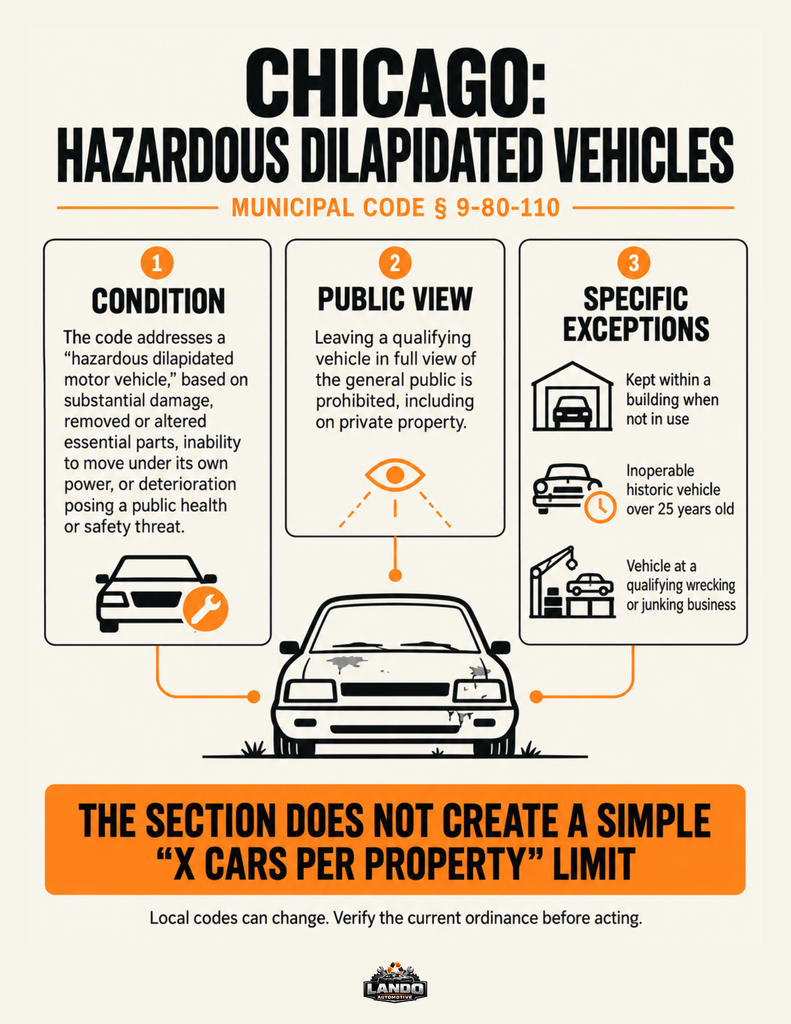
Chicago’s rule, Municipal Code § 9-80-110, is one of the more specific and frequently cited in the region.
Under this section, it’s unlawful to leave a “hazardous dilapidated motor vehicle” in full public view, and critically, this applies to both public and private property. A hazardous dilapidated motor vehicle is defined as one with a substantial number of essential parts damaged, removed, or altered so that it can’t be driven under its own power, or one so deteriorated that it poses a threat to public health or safety.
Chicago police and Streets and Sanitation personnel are authorized to issue a notice and arrange for immediate removal of a qualifying vehicle left in full public view.
There are specific exceptions:
- Vehicles kept inside a building when not in use
- Inoperable historic vehicles over 25 years old
- Vehicles on the premises of a legitimately operating wrecking or car junking business
Note what’s not in the ordinance: a specific numerical cap. A single hazardous dilapidated vehicle left visible on your lawn is enough to trigger enforcement. It doesn’t matter if it’s your first or your fifth.
Illinois Rules Outside Chicago
Outside city limits, Illinois handles this at the county level. Under 55 ILCS 5/5-1092, county boards are authorized to declare inoperable motor vehicles on public or private property a nuisance and to establish their own removal procedures and fines.
Because counties have this authority, Illinois state law does not set one uniform residential vehicle limit. Instead, each county can establish its own rules for inoperable vehicles, which means neighboring counties may have different limits, notice periods, and enclosure requirements. If you’re outside Chicago proper, your county’s municipal code, rather than a statewide number, determines what’s allowed.
What Do Northwest Indiana Rules Say?
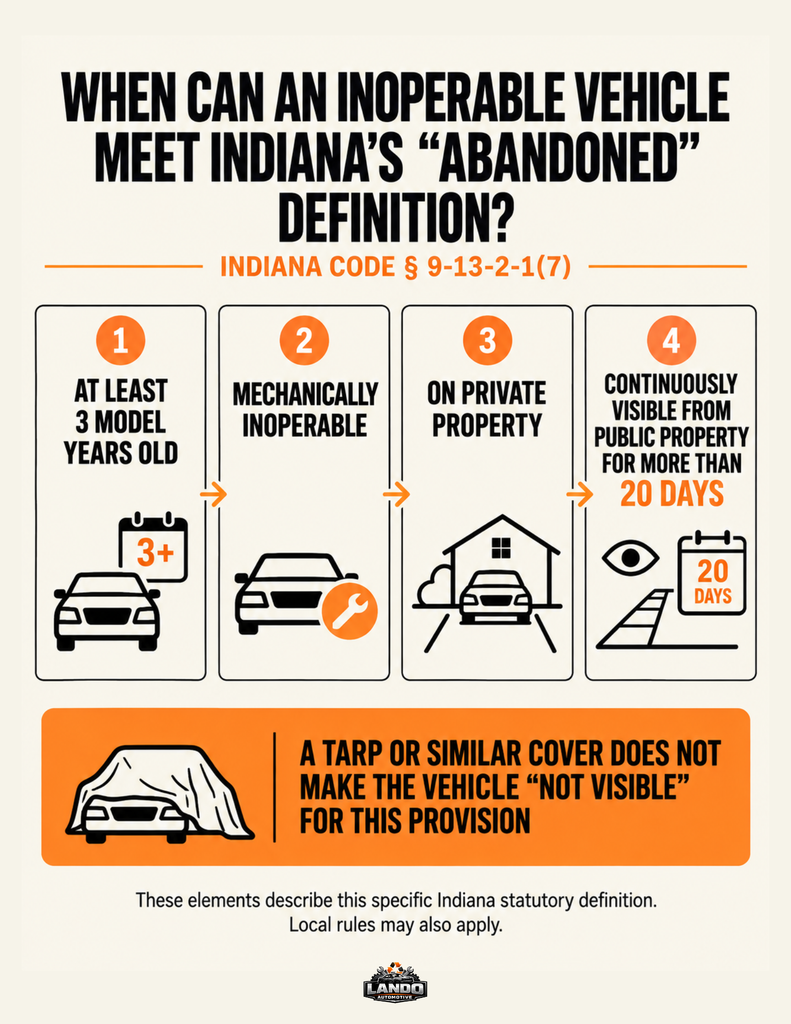
Indiana approaches this primarily through state statute, IC 9-13-2-1, which defines an “abandoned vehicle” in several ways relevant to private property. Among them, a vehicle that is at least three model years old, is mechanically inoperable, and is left on private property continuously and visibly from public property for more than 20 days qualifies. Notably, covering it with a tarp or similar material doesn’t exempt it, since the statute still treats a covered vehicle as “visible”.
Local Indiana municipalities, including cities like Hammond, layer their own code enforcement on top of this state baseline, typically through property-maintenance or nuisance-vehicle chapters in their local code of ordinances. Because local supplements to the state definition can differ from city to city (some tighten the visibility standard, some shorten the timeline), always confirm the current chapter with your specific municipality’s code enforcement division rather than relying on a general Indiana rule of thumb.
Can You Keep an Unregistered Car on Your Property?
An unregistered car may still violate local ordinances if it is inoperable, partially dismantled, improperly parked, visible from the street, considered hazardous, or stored in a prohibited area, such as a front yard. If you no longer plan to repair or keep the vehicle, finding a cash for junk cars service near you can be a practical way to remove it from the property instead of leaving it unused.
If the vehicle still has an outstanding lien, the process of getting rid of it can involve additional ownership and payoff considerations. If the vehicle is becoming increasingly expensive to repair or difficult to justify keeping, it may also be worth considering when to get rid of it rather than letting it sit unused.
Does a Garage, Fence, or Car Cover Make It Legal?
An enclosed building often provides the clearest protection because some local ordinances allow inoperable vehicles when they are kept inside a structure. However, this depends on the specific local rules.
A fence may help meet visibility requirements in some jurisdictions, but not all. Local codes may specify the required height or type of screening, so a standard privacy fence may not always qualify.
A car cover does not necessarily change a vehicle’s legal status. For example, Indiana law can still consider a covered vehicle visible under certain circumstances. Simply hiding a non-compliant vehicle does not make its storage lawful if it is later discovered or reported.
HOA (homeowners’ association) rules may also impose additional restrictions on vehicle storage. This means you could comply with city or county regulations while still violating your HOA’s covenants.
What Can Happen After a Code Violation?
The enforcement path is fairly consistent across jurisdictions, even though the specifics (fine amounts, notice periods) differ locally:
- Inspection or complaint investigation – Often triggered by a neighbor’s report or a routine code sweep
- Written notice – Formally identifying the violation and citing the applicable code section
- Time to repair, relocate, or remove – Deadlines vary by jurisdiction. If removal is necessary, learn how to junk a car and handle the title, pickup, and disposal correctly.
- Municipal citation or daily penalties – Some codes assess a new fine for each day the violation continues
- Towing and storage charges – Billed to the owner if the city or county removes the vehicle directly
- Administrative hearing or appeal rights – Most municipalities give owners a formal opportunity to contest the citation or towing before final enforcement
Final Takeaway
How many junk cars can you have on your property depends largely on local rules, but the number alone is rarely the only factor. The vehicle’s condition, visibility, location, and how long it remains on the property can all affect whether it violates local regulations. Even one visibly abandoned or hazardous vehicle may attract enforcement, while properly stored vehicles may be treated differently.
Whether you’re dealing with Chicago’s code, an Illinois county ordinance, or Indiana’s state requirements, checking the rules that apply to your property is the safest approach. Keep vehicles properly stored, address any notices promptly, and remove unwanted junk cars when necessary to avoid ongoing code issues.