
Every car owner eventually reaches the exact same stressful fork in the road: do you keep paying to fix your current ride, or do you finally let it go?
It is easy to get emotionally attached to your vehicle, but guessing your next move can cost you thousands. You need a concrete strategy to determine when to get rid of a car before it turns into a permanent money pit.
This guide breaks down the exact financial thresholds and mechanical red flags that experts use to make the call. By using these real-world rules, you can make your final choice using cold, hard numbers instead of stressful guesswork.
When to Get Rid of a Car
The average vehicle on U.S. roads is now nearly 13 years old. This means millions of drivers are cruising in vehicles entering their highest-repair years.
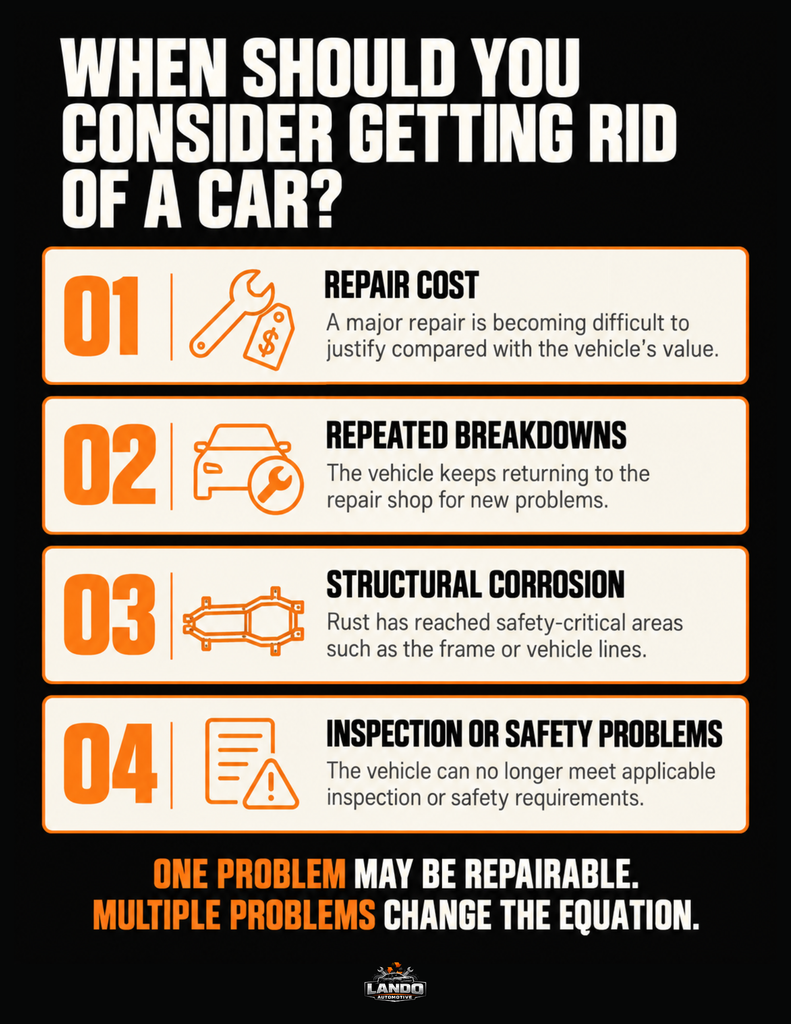
Knowing exactly when to junk a car comes down to tracking specific red flags. You should consider replacing your vehicle if it meets any of the following criteria:
- The 50% repair rule – A single repair costs 50% or more of the car’s total market value.
- The frequency trap – The vehicle requires major shop visits more than once every six to 12 months.
- Structural rust – Corrosion reaches critical areas like the frame, fuel lines, or brake lines.
- Legal dead ends – The car completely fails a state safety or emissions inspection.
Critical mileage danger zones
Mileage plays a massive role in your vehicle’s survival rate. Keep a close eye on these odometer thresholds:
- 90,000 to 120,000 miles – Expect a cluster of expensive, standard part failures (like timing belts and water pumps).
- 150,000 miles and beyond – The odds of a catastrophic engine or transmission failure rise sharply.
None of these warning signs mean an automatic trip to the scrapyard on their own. However, when two or more of these red flags show up at the exact same time, the math almost always favors replacement over another repair.
Repair Bills That Cost More Than the Car Is Worth
Mechanics and financial advisors widely use what’s known as the 50% rule. So, if a repair costs more than half of what the car is currently worth, replacing the car beats fixing it. The logic is simple. A car is a depreciating asset, and once a repair bill matches or exceeds its market value, you’re spending more to keep the asset than the asset is worth.
Here’s the math in practice. A 10-year-old sedan is worth $2,000 at trade-in. The transmission fails, and the shop quotes $2,500 to replace it. That repair is 125% of the car’s value, well past the threshold, and the money is better spent toward a replacement vehicle.
Pull the actual trade-in or private-sale number from Kelley Blue Book or Edmunds before you decide, since guessing at the car’s worth is what leads owners to over-invest in a losing repair. And once a car crosses this line, its real value shifts. It stops being worth what a buyer would pay to drive it and starts being worth its scrap and parts value instead, a separate and usually much smaller number.
Mileage and Age Milestones That Signal Decline
Certain mileage bands consistently correlate with expensive failures across most makes and models. Timing belts typically need replacement between 60,000 and 100,000 miles, at a cost of $400 to $1,200. Skip it on an interference engine and a snapped belt can cause $3,000 to $8,000 in engine damage.
CV axle boots start cracking and drying out around 100,000 miles; catching a torn boot early costs about $20, but ignoring it turns into a $400 axle replacement. Suspension components including bushings, ball joints, and tie rod ends also commonly show wear by the 100,000-mile mark.
Mileage alone doesn’t decide anything. A well-maintained car with documented service history can outlast these bands by tens of thousands of miles. But once a vehicle crosses 90,000 to 120,000 miles without that maintenance record, the odds that the next repair is a big one rise substantially, and by 150,000 miles a car is statistically closer to its end of service life than its beginning.
Rust and Frame Damage That Can’t Be Repaired
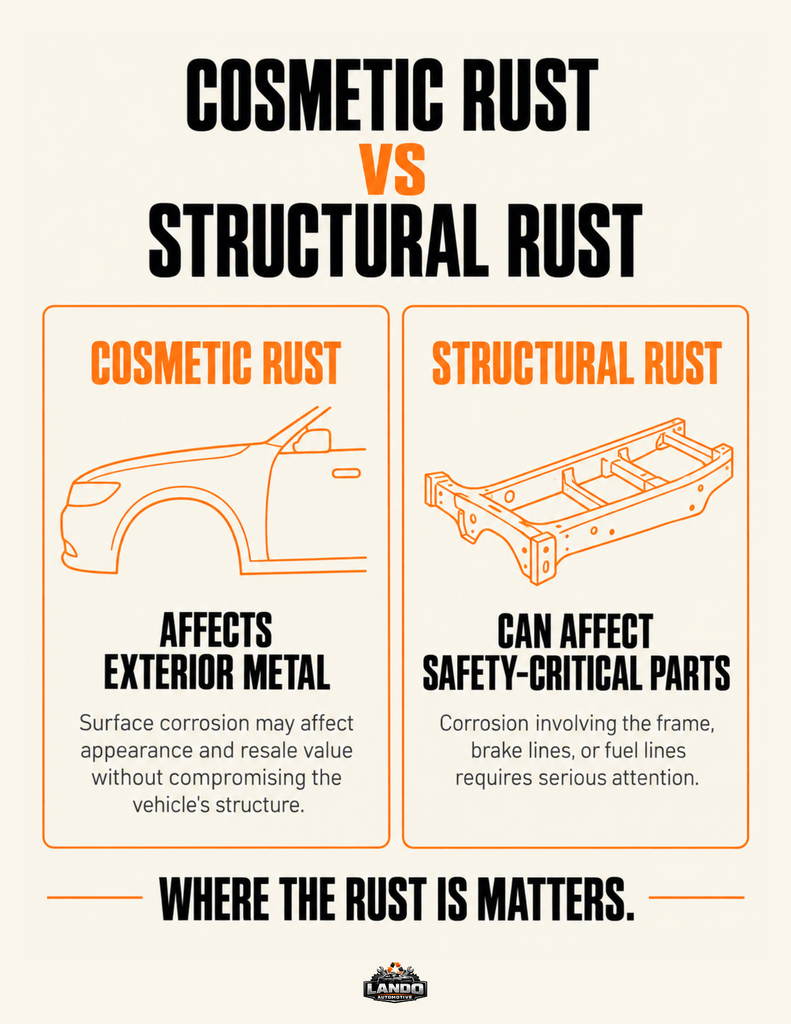
Not all rust means the same thing. Surface rust on body panels is cosmetic. It affects appearance and resale value, but it isn’t urgent. Structural rust is different. Rust that reaches the frame, brake lines, or fuel lines compromises the parts of the car that keep it safe to drive. Corroded brake lines can lead to brake failure. Corroded fuel lines can leak. Neither is a problem to defer.
When rust repair isn’t worth attempting
If a shop quotes frame or structural rust repair and that quote exceeds the car’s market value, repair isn’t the rational choice anymore. This is the point where most owners stop chasing the rust and start looking at their exit options, since a heavily rusted car that isn’t worth fixing can still carry real scrap and parts value.
Recurring Breakdowns and a Persistent Check Engine Light
A car that returns to the shop for a different problem every few months is a reliability problem, not just a cost problem. Each individual repair might be affordable on its own, but a car you can’t trust to start is a bigger liability than any single bill.
A check engine light that stays on after multiple repair attempts is a specific version of this pattern. It usually points to a deeper issue in the engine, transmission, or electrical system that the earlier repairs didn’t actually fix. At that point, the question isn’t whether the next repair will work. It’s how many more attempts you’re willing to pay for before you stop.
Failed Inspections and Safety Concerns
A failed state safety or emissions inspection isn’t just a maintenance flag; it’s a legal barrier to driving the car at all in states that require passing inspection for registration. Separate from inspection failures, older vehicles often lack safety equipment that’s now standard, including airbags and anti-lock brakes. A car can pass inspection and still be missing this kind of protection, which is a safety consideration on its own, independent of what the inspection sticker says.
A Car That No Longer Fits Your Life
Not every reason to get rid of a car is mechanical. A growing family, a move to a walkable city, a shift to remote work, or a change in commute can all mean the car you have no longer matches the life you’re living. This is a smaller share of the reasons people search for when to get rid of a car compared to the mechanical signs above, but it matters.
A car in this category is often still running fine, which changes the calculation: instead of choosing between repair and replacement, you’re choosing the best way to convert a working asset into cash, a trade-in, or a donation.
What Waiting Too Long Actually Costs You
Holding onto a car past its useful point has a cost even when nothing is actively broken. Insurance and registration continue whether the car is driven daily or sits mostly idle. A breakdown on your own schedule, in your own driveway, costs nothing extra. A breakdown on the highway at rush hour adds a tow bill and, often, a rental car on top of the repair.
And a car’s scrap and parts value doesn’t improve with time. Parts get harder to sell as a model ages out of demand, and rust or mechanical damage spreads rather than staying still. There’s no version of waiting that makes the car worth more later.
Comparing Your Options for Getting Rid of a Car
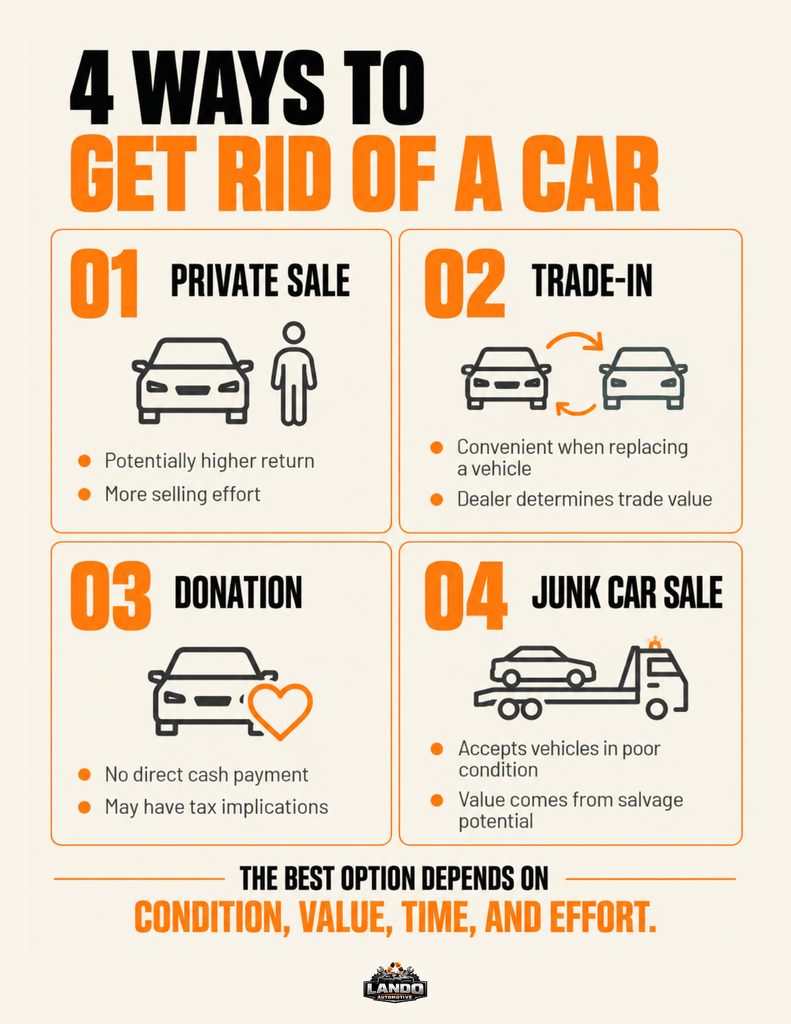
Each path for getting rid of a car asks something different of the vehicle and of you. Here’s a quick comparison:
| Option | Typical Payout | Time to Complete | Car Condition Required | Effort Required |
| Private Sale | Highest of all options; full market value | Days to several weeks | Running, presentable, passes inspection | High – listing, showings, negotiating, paperwork |
| Trade-In | Below private-sale value, often 15-25% less | Same day, folded into a new purchase | Running preferred, but dealers accept most conditions | Low – dealer handles paperwork |
| Donate to Charity | No cash; potential tax deduction based on sale value | Days to a week for pickup | Any condition, including non-running | Low – schedule pickup, file tax paperwork |
| Sell to a Junkyard | $200-$1,500+ depending on weight, condition, and metal market | Often same day to 48 hours | Any condition, including non-running, wrecked, or incomplete | Lowest – one call or quote request, no listing or negotiating |
Private sales offer the highest payout but require a running car and the most effort. In comparison, trade-ins are fast and easy but pay much less. Alternatively, donation accepts any condition and gives a tax deduction instead of cash. While junkyards are the fastest option and reliably buy any vehicle, even if it doesn’t run.
Frequently Asked Questions
What’s the difference between selling, trading in, and junking a car?
A private sale means finding your own buyer and negotiating a price directly, which usually takes the most time but can bring the highest return on a running, presentable car. A trade-in happens through a dealership as part of buying another vehicle, and it’s fast but typically pays less than a private sale. Junking a car means selling it for its scrap and parts value to a buyer who takes it regardless of whether it runs, which is the right option once a car’s condition has dropped below what a private buyer or dealership will accept.
Do I need my car to run to junk it?
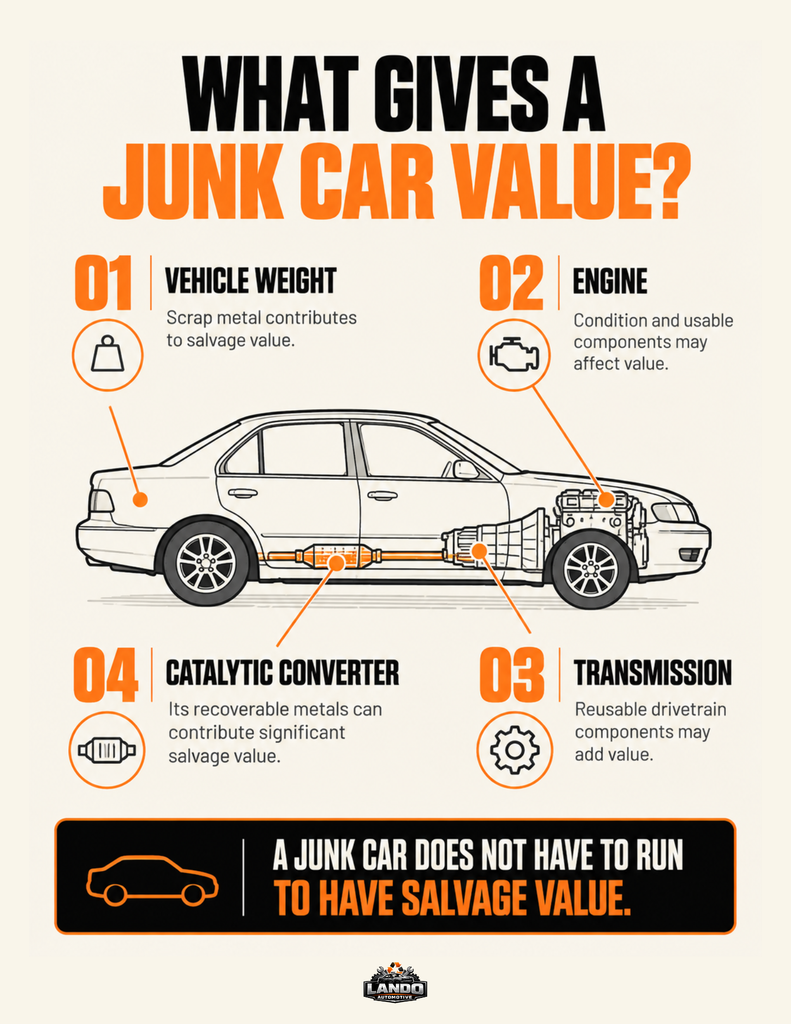
No. Junkyards and junk car buyers routinely purchase vehicles that don’t start, have missing parts, or have significant damage, since the value comes from the metal weight, working components, and catalytic converter rather than the car’s ability to drive.
What paperwork do I need to junk a car?
At minimum, you’ll need the vehicle’s title to transfer ownership legally, although the rules can vary depending on the situation and state, including whether a title is required. Some states also require current registration or a bill of sale. It’s worth canceling your auto insurance policy once the car is picked up, so you’re not paying to insure a vehicle you no longer own.