
An abandoned car in the driveway ruins property curb appeal. Every single day the vehicle sits there, homeowners lose valuable storage space. It also drains peace of mind to look at a rusty junker that gathers dust and leaks oil. Local city codes might even create costly fines for keeping an unregistered vehicle on the property.
The goal is to remove the vehicle and get paid immediately without any unnecessary stress. Discover whether can you junk a car without a title as this article covers the legal rules, necessary paperwork, and steps to get cash for your junk car fast.
Can You Junk a Car Without a Title?
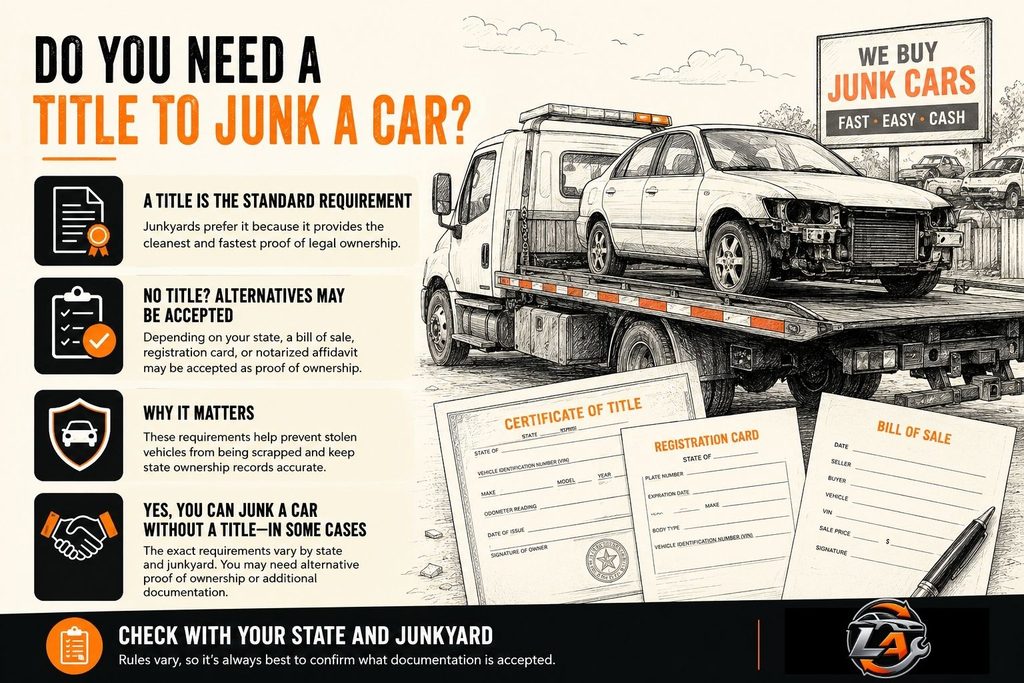
A car title is the standard requirement, but it isn’t always absolute. Junkyards prefer it because it provides the cleanest and fastest proof of legal ownership. Without a title, you are not necessarily stuck, but you may have more legwork ahead of you.
The important distinction is between legal ownership and paperwork requirements. You must have the legal right to transfer the vehicle, but a title is not always the only document that can prove ownership. Depending on your state, a bill of sale, registration card, or notarized affidavit may be accepted as an alternative.
These requirements exist to help prevent stolen vehicles from being scrapped and to keep state ownership records accurate. If ownership cannot be properly documented, the junkyard may refuse the vehicle or require additional paperwork before accepting it.
So, can you junk a car without a title? Yes, in some cases. The exact requirements vary by state and junkyard, so you may need alternative proof of ownership or additional documentation before the vehicle can be scrapped.
How to Junk a Car Without a Title
Before diving into the details, here’s the roadmap:
- Confirm the car has no active lien – A lien can prevent you from transferring the vehicle, whether you have the title or not.
- Gather alternative proof of ownership – This may include registration, a bill of sale, or government issued ID.
- Check your state’s requirements – Some states allow ownership affidavits or other alternatives to a title.
- Apply for a duplicate title – If the junkyard requires a title, replacing a lost one may be the simplest option.
- Contact a junkyard that accepts vehicles without titles – Ask for its required documents before scheduling the pickup and review the process of junking a car beforehand.
What Documents Do You Need to Junk a Car
The documents you need ultimately determine whether the sale goes through smoothly or gets delayed.
Getting a duplicate or replacement title
If you have time before you need the car gone, replacing the title is usually the cleanest path. It typically means filing a short application with your state’s DMV and paying a modest fee. The process is nearly identical from state to state, even if the exact form number and cost vary.
Processing time is the real variable. Some states process duplicate title requests by mail in a couple of weeks; others offer expedited or same-day service if you apply in person. If your junkyard deadline is flexible, it’s worth calling your local DMV to ask which option they offer. The 10 minutes on hold can save you a lower offer later, since titled vehicles routinely fetch more than titleless ones.
Alternative ownership documents
If waiting on a new title isn’t realistic, most licensed junkyards will accept a combination of the following instead:
- Current or recent vehicle registration – Even an expired one showing your name attached to the VIN carries weight.
- Notarized bill of sale – A record of when and how you acquired the vehicle, ideally with the seller’s signature.
- Valid government-issued photo ID – Matched against the VIN to establish you as the person making the claim.
- Affidavit of ownership – A sworn statement, where your state allows it, that you own the vehicle and have the right to dispose of it.
One important distinction is that if there is an active loan on the car, a lien release is a separate requirement from the title question entirely. No document substitution gets around an unpaid lien. The lender has a legal claim on the vehicle until that balance is cleared.
None of this is universal. What one yard accepts, another might reject outright. Before you commit to a buyer, ask them directly what their documentation policy is for a titleless vehicle.
Junking a Car That Isn’t in Your Name
Junking a car that is registered to someone else is more common than you might expect and generally falls into two different categories.
Inherited or a deceased owner’s vehicle
When a car belonged to someone who has passed away, the title itself often can’t simply be signed over. Ownership usually has to pass through probate first, or through a state-specific small-estate affidavit process. In most cases, it’s the executor of the estate or the next of kin who holds the legal authority to sell or junk the vehicle, not just whoever happens to have the keys. Probate rules vary significantly by state, so if you’re in this situation, a quick call to your local probate court or DMV title office is worth more than guesswork.
A car left behind by a previous owner or tenant
If a vehicle was abandoned on your property by a former tenant, a previous homeowner, or a stranger entirely, you generally cannot legally junk it just because it’s sitting there. The correct path is reporting it as an abandoned vehicle to local law enforcement or your local DMV. Most jurisdictions require a holding period before legal authority to dispose of the car transfers to the property owner, and that process has to run its course before any junkyard can legally take it off your hands.
What Happens If You Have No Paperwork At All
Here’s the scenario nobody wants to be in: no title, no registration, no bill of sale, nothing.
It’s not hopeless, but it’s also not a guaranteed fix, and you deserve a straight answer, not false reassurance. Your realistic options are:
- Report the vehicle as abandoned – Contact local authorities if you cannot establish ownership. This may start a legal process allowing the vehicle to be disposed of.
- Contact the DMV directly – Ask if they can trace the ownership record using the VIN. Some states can reconstruct records when documents are missing.
- Find a junkyard with a no-title intake process – Some junkyards accept vehicles without titles after checking the VIN for stolen vehicle and lien records.
Be honest with yourself here, as some yards will simply say no. A missing title is a solvable problem. A total absence of any ownership trail is a genuinely harder one, and no guide should tell you otherwise.
Finishing the Process After You Junk the Car
The tow truck pulling away does not mean you are done. This is the step many people skip, often at their own expense later.
Remove and surrender or transfer your license plates, and make sure you know remove important stuff in the vehicle before it’s picked up. Most states require plates to be returned to the DMV rather than left with the vehicle. You should also file a release of liability or notice of transfer with the DMV to formally end your legal connection to the vehicle.
Finally, cancel your insurance policy, but only after the transfer paperwork is confirmed. Think of this stage as closing out your legal responsibility for the vehicle, not a formality. Skipping it could leave you responsible for a parking ticket, toll violation, or other issue if the vehicle ends up back on the road.
Frequently Asked Questions
Do I need to pay off a lien before junking a car without a title?
Yes. A lien gives your lender a legal claim on the vehicle, and that claim exists independently of whether you have a title. No junkyard can legally accept a car with an active lien until it’s released by the lender.
How long does it take to get a duplicate title before junking a car?
It varies by state. Some process mail-in applications in a couple of weeks, while others offer same-day or expedited service for an in-person visit. Check with your local DMV for the timeline in your area.
Will every junkyard accept a car with no title?
No. Policies differ significantly between buyers. Reputable, licensed junkyards are required to verify ownership in some form, so always confirm a specific yard’s documentation requirements before scheduling a pickup.
What if my state doesn’t issue titles for older vehicles?
Some states exempt vehicles above a certain age from title requirements, relying instead on registration history or a bill of sale as proof of ownership. Since these thresholds and rules vary, it’s worth confirming directly with your state DMV rather than assuming your vehicle qualifies.