
The number of cars scrapped each year shows how quickly vehicles leave the road and enter the recycling system. That number can change from year to year as vehicle age, sales, economic conditions, and repair costs change. Looking at these trends provides a clearer picture of how many vehicles ultimately reach the scrapyard.
Our team at Lando Automotive in this article breaks down exactly how many cars are scrapped each year in the United States and globally. Discover how these statistics compare across the world, why the totals shift from year to year, and which specific vehicle models end up at the scrapyard most often.
How Many Cars Are Scrapped Each Year in the US
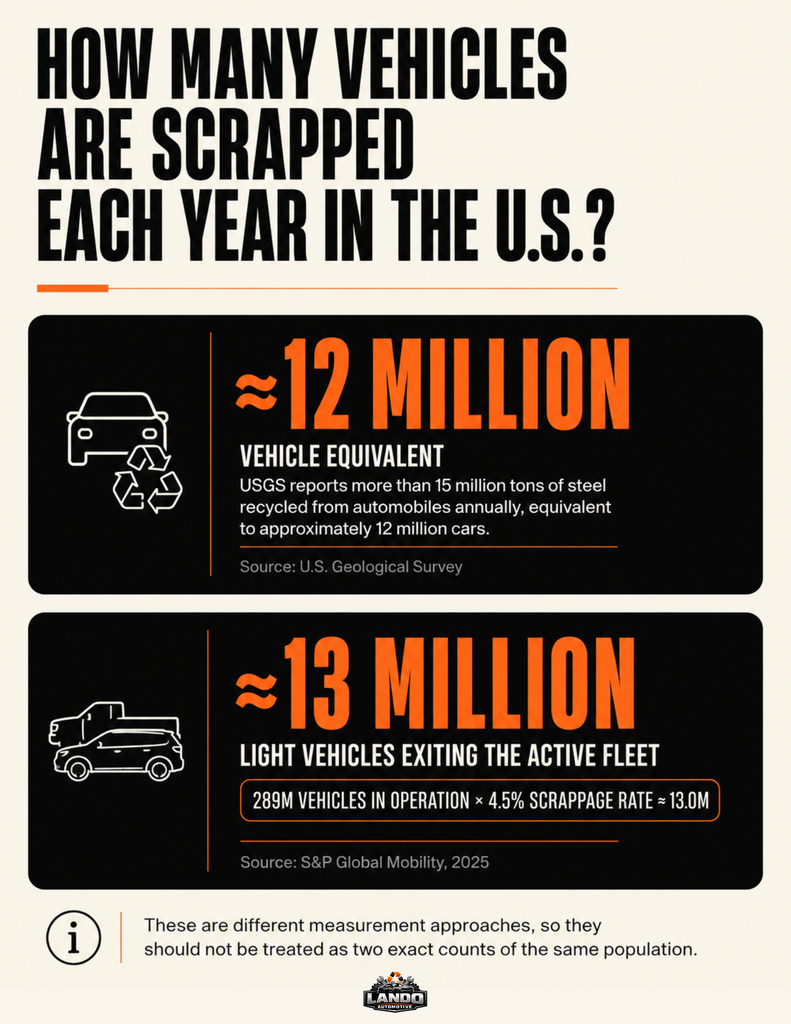
The U.S. Geological Survey reports that more than 15 million tons of steel are recovered from automobiles each year, representing roughly 12 million vehicles based on the amount of steel recycled. This provides one indication of the scale of vehicle recycling in the United States.
A separate estimate from S&P Global Mobility provides another way to measure the market. The company reported 289 million light vehicles in operation in the U.S. in 2025, along with a 4.5% scrappage rate. Applying that rate to the vehicle fleet produces an estimated 13 million vehicles leaving the active fleet each year.
That works out to about 1.08 million vehicles per month or 35,600 per day. The estimate is also broadly consistent with the Automotive Recyclers Association (ARA), which says automotive recyclers process more than 12 million vehicles annually.
Scrapped vs. Junked vs. Recycled – What the Numbers Mean
Industry reporting may use “scrapped” and “junked” to describe vehicles that are permanently removed from active use because of age, damage, or mechanical failure. “Recycled” describes what happens to the vehicle’s materials afterward. The Automotive Recyclers Association reports that approximately 86% of a vehicle’s material content is recycled, reused, or used for energy recovery.
Scrappage counts and recycling rates are different metrics. Vehicles in operation (VIO) provides the fleet base used to calculate a scrappage rate.
When S&P Global Mobility reports a 4.5% scrappage rate against 289 million vehicles in operation, it is measuring vehicles leaving the active fleet. The ARA measures a different part of the process. Its industry statistics report that automotive recyclers process more than 12 million vehicles per year, while approximately 86% of a vehicle’s material content is recycled, reused, or used for energy recovery.
Why the terms get confused in reporting
Scrappage and recycling figures are often presented together, even though they measure different things. A scrappage figure counts vehicles leaving the active fleet, while a recycling figure describes what happens to the vehicle or its materials afterward.
For example, the commonly cited 12 million vehicles figure refers to vehicles processed by automotive recyclers, while the ARA’s 86% figure refers to material content that is recycled, reused, or used for energy recovery. These figures shouldn’t be treated as percentages of the same total.
How Many Cars Are Scrapped Each Year in the World
Global figures are harder to pin down because countries use different definitions and reporting systems for end-of-life vehicles. Unlike the United States, global reporting is more fragmented, making worldwide totals difficult to verify consistently. Industry and recycling-sector sources commonly estimate that around 27 million vehicles reach the end of their useful lives and are recycled worldwide each year.
The U.S., Europe, Japan, China, and India generate large volumes of end-of-life vehicles, but the share handled through formal recycling systems varies by country. China and India generate the fastest-growing supply of end-of-life vehicles but have the weakest formal tracking. India’s Vehicle Scrappage Policy, which set up a national network of registered scrapping facilities starting in 2021, exists specifically because so much of the country’s fleet previously had no formal disposal path at all.
Estimated annual vehicle scrappage by region
| Region | Est. Vehicles Scrapped/Recycled Per Year | Formal Recycling Rate | Source |
| United States | ~12-13 million | 86% of ELVs | USGS, ARA, S&P Global Mobility |
| United Kingdom | 798,363 cars and light commercial vehicles scrapped from January to October 2023 | Not available | DVLA data via Autocar |
| European Union | Not consistently published as a single EU-wide figure | 85% reuse and recycling; 95% reuse and recovery | EU End-of-Life Vehicles Directive |
| China / India | Fast-growing, formal tracking still developing | Improving under new national mandates | National scrappage policy announcements |
| Global Total | 27 million (industry estimate, not a single verified count) | Varies widely by country | Multiple industry trackers |
Why the Number Changes From Year to Year
The scrappage rate changes with the age of the fleet, vehicle prices, economic conditions, and how many vehicles reach the end of their useful life each year. S&P Global Mobility says the aging fleet reflects changes in consumer purchasing behavior, economic conditions, and vehicle durability.
That helps explain why annual scrappage totals can change even as the overall fleet grows. The average U.S. vehicle age reached 12.8 years in 2025, with passenger cars averaging 14.5 years and light trucks 11.9 years. The fleet also grew to 289 million vehicles, up about 3 million from the previous year, while the scrappage rate remained at 4.5%.
EVs have a much younger fleet for now. S&P Global Mobility puts the average age of battery electric vehicles at 3.7 years, meaning they currently make up a relatively small share of vehicles reaching typical end-of-life ages.
Why Cars Get Scrapped
Age and mileage
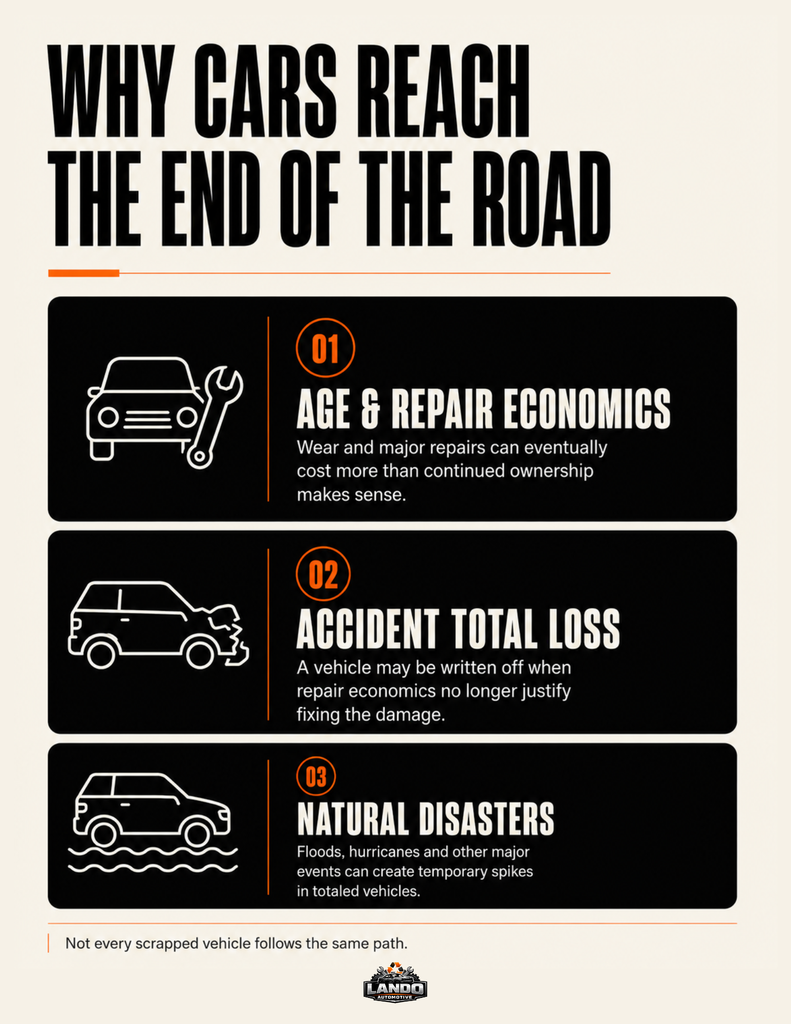
Most vehicles are scrapped after years of use, when age, wear, and rising repair costs make keeping them on the road less economical. As vehicles get older, the risk of mechanical problems increases, while major repairs can eventually cost more than the vehicle is worth. Economic conditions, maintenance costs, vehicle prices, and accident damage can also influence when a vehicle reaches the end of its useful life.
Accidents and insurance total losses
Accidents are another major reason vehicles end up being scrapped. When the cost of repairing a damaged vehicle becomes too high compared with its value, an insurer may declare it a total loss rather than pay for repairs. Once a vehicle reaches that point, junking a car depends on the owner, insurer, and the buyer or recycler handling the vehicle.
This is becoming more common as repair costs rise and the U.S. vehicle fleet gets older. CCC Intelligent Solutions reported that total losses reached 23.1% of auto claims, a record high, with older vehicles and rising repair costs contributing to the increase.
Natural disasters
Hurricanes and floods add a smaller, less predictable spike to the total. Major storm seasons can damage hundreds of thousands of vehicles at once, a large share of which end up totaled and routed to salvage rather than repair.
Most Scrapped Cars
Model-level scrappage data is easier to find in the UK, where services such as Scrap Car Comparison publish annual breakdowns based on their own scrap and salvage data. The U.S. does not have an equivalent public model-by-model dataset, making direct comparisons more difficult.
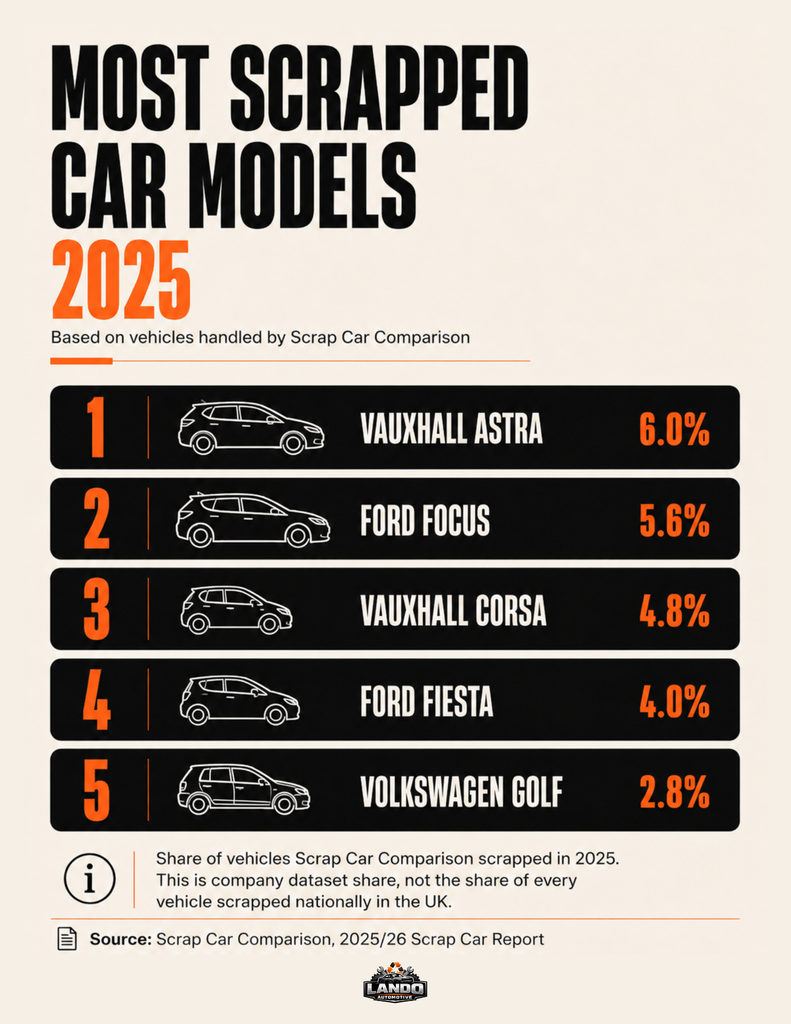
For 2025, Scrap Car Comparison’s data put the Vauxhall Astra at the top of the list, accounting for 6% of the vehicles it scrapped that year. The Ford Focus, which had held the top spot for eight consecutive years, fell to second with 5.6%.
Most scrapped car models (UK, 2025)
| Rank | Make and Model | Share of Total Scrapped |
| 1 | Vauxhall Astra | 6.0% |
| 2 | Ford Focus | 5.6% |
| 3 | Vauxhall Corsa | Top 5 |
| 4 | Ford Fiesta | Top 5 |
| 5 | Volkswagen Golf | Top 5 |
The U.S. does not publish model-level scrappage data at the same level of detail as the UK. The broader pattern is still useful, though. Models with high original sales volumes and 15 or more years on the road are more likely to appear on future scrap lists.
Frequently Asked Questions
Do scrappage figures include motorcycles, trucks, and buses, or only passenger cars?
The headline US figures from USGS and S&P Global Mobility cover light vehicles, meaning passenger cars and light trucks. Motorcycles, heavy trucks, and buses are tracked separately and aren’t part of the 12-13 million figure.
Can a car be scrapped while it still runs?
Yes. Insurance total losses and voluntary trade-in programs regularly send running vehicles to recyclers once repair costs or resale value make continued ownership impractical.
What happens to an EV’s battery when the vehicle is scrapped?
Lithium-ion packs get removed before the rest of the vehicle is processed, since they carry a fire risk if crushed or shredded whole, alongside other components and materials that need to be removed before processing. Recyclers route them to dedicated battery recycling or second-life storage programs instead of standard shredding lines.
How long does it take to fully process a scrapped car?
Depollution (draining fluids and removing hazardous materials) and parts removal typically take a facility a few hours to a few days per vehicle. The shell can then sit in inventory for weeks before reaching a shredder, depending on local scrap steel demand.