
A scrapyard pays for weight. It doesn’t pay extra for the battery, the catalytic converter, or the wheels sitting on top of that weight, and once the tow truck leaves, everything still bolted to the car goes with it. Knowing what to remove from car before scrapping, and in what order, is the difference between a flat scrap check and walking away with several hundred extra dollars for parts you pulled yourself.
Our team at Lando Automotive in this guide covers what to do before scrapping a car step by step, including personal items, resale parts, fluids, plates, and the paperwork that actually closes the sale.
What to Remove From Car Before Scrapping
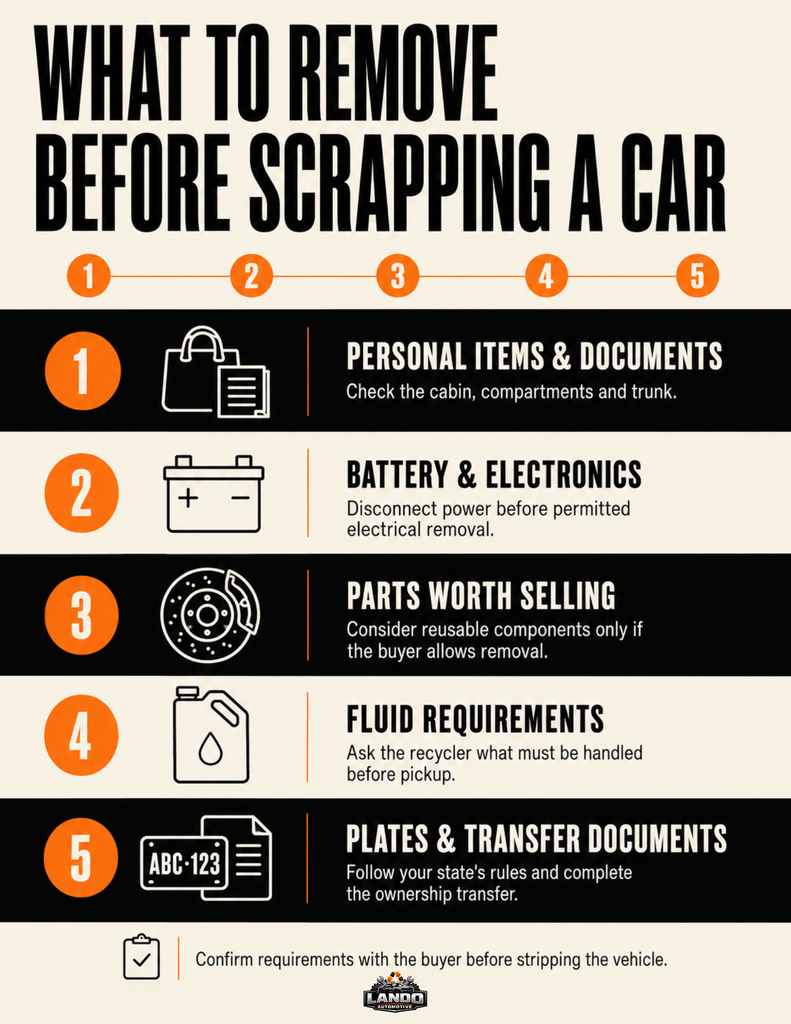
Before the car is picked up, work through these five steps in order. This helps protect your paperwork, recover value from reusable parts, and avoid problems at handoff.
1. Personal items and documents
Remove your registration, insurance card, title, and anything stored in the glove box, trunk, or other compartments. Handle this first while the car is still whole so nothing gets buried or lost during the process.
2. Battery and electrical components
Disconnect the battery’s negative terminal before removing electrical components. If you plan to sell aftermarket electronics or other reusable parts, remove them only after you disconnect the power.
3. Parts worth selling separately
Consider removing the battery, wheels and tires, catalytic converter, aftermarket electronics, and other valuable parts if the buyer allows it and they are worth more separately. Pull high-value parts while the car is still on its wheels, since they are generally easier to access before the vehicle is raised or stripped.
4. Fluids the yard does not accept
Check with the buyer to confirm whether fuel, motor oil, coolant, or refrigerant must be removed before pickup. If draining is required, do it shortly before the tow rather than removing fluids too early and storing them unnecessarily.
5. License plates and title
Remove the license plates and return or transfer them according to your state’s requirements. Keep the title ready to sign over at handoff. Once the vehicle is transferred and payment is collected, keep copies of the title paperwork, bill of sale, and receipts for your records.
Personal Belongings and Paperwork to Take Out
People check the glove box and forget four other places items collect over years of driving: the center console, under the seats, the trunk liner (registration and insurance cards slide under there more often than owners expect), and the door pockets. Pull the registration and insurance card specifically, not just “documents” in general, since both get requested later if you register a replacement vehicle or need proof the old one was insured at the time of sale.
Once the tow truck has the car, anything left inside is gone. Scrapyards process vehicles fast, and a car that arrives on a Tuesday can be stripped and crushed by the weekend.
Valuable Parts Worth Removing First
A scrapyard’s offer is based on the vehicle’s steel weight and the going scrap-metal rate, not on what any individual part could sell for on its own, so it’s worth considering whether the car is worth getting rid of before stripping valuable parts. The parts below routinely bring in more money sold separately than they add to the scrap quote.
Battery, wheels, and tires
A used car battery is not worth much by weight alone, roughly $5 to $10 at a scrap yard based on lead content, but many auto parts retailers offer a $10 to $25 core refund for the same battery, since it saves them a recycling step. Either way, disconnect the negative terminal first, then the positive, before removing the hold-down bracket.
Alloy wheels with usable tread hold resale value on their own, separate from the car’s scrap weight. One thing to plan for – a car needs wheels or a flatbed to be towed, so if you are pulling wheels before pickup, arrange a replacement set or confirm the yard is sending a flatbed.
Catalytic converter
The catalytic converter has been standard equipment on U.S. gasoline vehicles since the 1975 model year, when EPA emissions rules made it effectively mandatory, and it remains one of the most valuable parts on an otherwise ordinary car. It works because of the platinum, palladium, and rhodium coating its internal honeycomb – metals with no practical substitute for the nitrogen-oxide reduction that rhodium specifically performs.
Rhodium alone was trading above $9,500 an ounce as of January 2026. Scrap value on an intact converter typically runs $50 to $1,200 or more depending on the vehicle, with high-loading units like the Toyota Prius’s converter reaching $300 to $700 on their own.
Removal requires a wrench or a cutting tool and, in most states, documentation to sell it separately. Between 2021 and 2022, 32 states passed laws requiring sellers to show proof of ownership, typically a title, registration, or bill of sale, before a scrap buyer can legally purchase a detached converter. This is a response to a wave of converter theft, not a barrier for legitimate owners, but it means showing up with your title matters here, not just at final handoff.
Aftermarket electronics
Aftermarket stereos, speakers, subwoofers, dash cams, and GPS units are yours to keep and worth pulling before the car leaves. Factory-installed infotainment systems and OEM electronics are a different case. They are typically wired into the car’s broader electrical system and usually make more sense to leave in place unless you know exactly what you are disconnecting.
Fluids and Hazardous Materials to Drain First
Many yards ask sellers to drain or flag fuel, motor oil, coolant, and refrigerant before or during pickup, since disposing of these fluids properly involves environmental rules and, in some cases, hazmat fees the yard passes on to the seller if the car arrives full. Practices vary by yard, so confirm what a specific buyer requires rather than assuming a blanket rule. Draining gas is worth doing regardless, as it is fuel you can use in another vehicle rather than fluid a yard has to dispose of on your behalf.
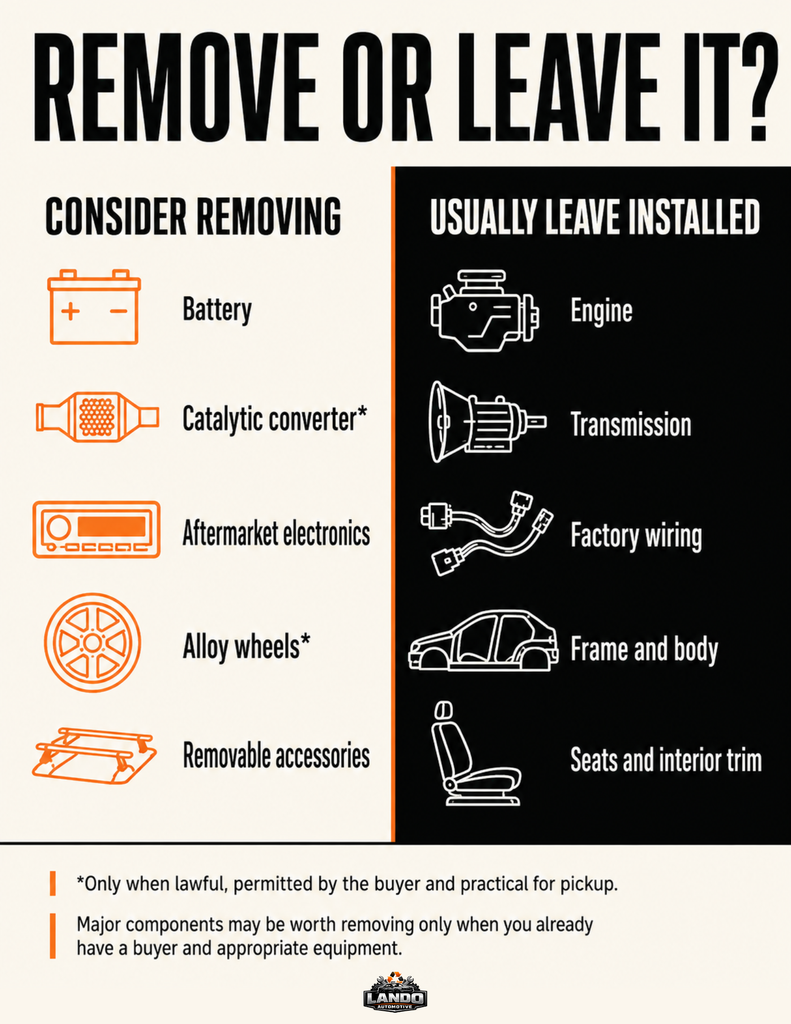
Parts That Should Stay on the Car
Pulling too much before the tow can backfire. A stripped car often draws a lower quote, or gets refused outright, since yards price vehicles assuming a baseline of intact components.
| Remove and Sell Separately | Leave on the Car |
| Battery | Engine block and internals |
| Catalytic converter | Transmission (unless you have a confirmed buyer and removal help) |
| Aftermarket stereo, speakers, dash cam | Factory wiring harness |
| Alloy wheels (with a replacement set or flatbed arranged) | Frame and body panels |
| GPS unit, phone charger accessories | Seats and interior trim (unless pre-sold) |
If you have a confirmed buyer lined up for something bigger, like an intact engine or transmission, that changes the math. A full transmission replacement runs $2,500 to $8,000 at a shop depending on the vehicle, which is exactly why a used, working unit is worth pulling and selling directly rather than leaving it in a car headed for the crusher, if you have the tools and a buyer in hand before you start.
License Plates and Title Transfer
Plate removal is required by nearly every state before a scrapyard will process a vehicle, though the exact rule and what you do with the plates afterward varies by state. Once the plates come off, contact your insurance provider to update or cancel coverage on that vehicle; a car with no valid registration sitting in a scrapyard’s lot does not need active coverage.
Signing over the title is the step that actually finalizes the transfer, but the steps involved in junking a car extend from preparing the vehicle through pickup and payment. Until that signature happens, the vehicle is still legally yours, along with any liability tied to it.
Frequently Asked Questions
Do I need the original title to scrap a car if it’s lost?
Most states allow you to request a duplicate title through your state’s DMV before completing the sale, and most scrapyards will not process the vehicle without one.
Will a junkyard tow a car that doesn’t start?
Yes. Most junk car buyers offer free towing regardless of whether the vehicle runs, using a flatbed or winch for non-running cars.
Do I need the original keys to scrap a car?
No. A non-running or key-less vehicle can still be towed and processed; keys are helpful but not required.
Can I keep a personalized or vanity plate instead of scrapping it with the car?
In most states, yes, but you typically need to formally transfer or retain the plate through your state’s DMV before the car is picked up, not after.